Iowa Environmental Council: Public health connection to pollution can’t be ignored
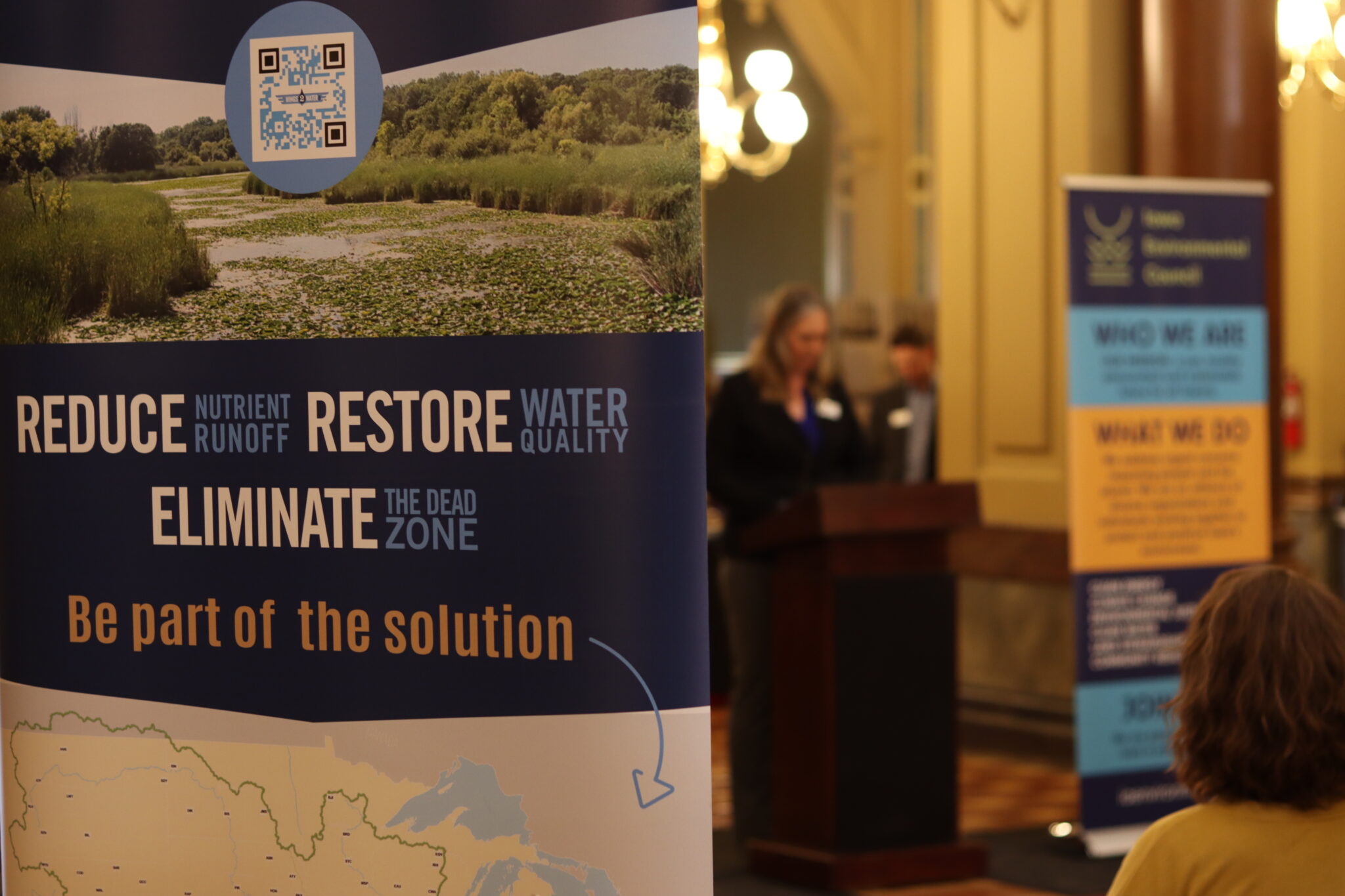
Iowa Environmental Council and partnering organizations gathered in the Iowa Capitol Rotunda Feb. 25, 2026 to advocate for water quality and environmental policies. (Photo by Cami Koons/Iowa Capital Dispatch)
by Cami Koons, Iowa Capital Dispatch
February 25, 2026
Advocates and partners of the Iowa Environmental Council gathered in the Iowa Capitol rotunda Wednesday to advocate for Iowa’s water, air and environmental concerns.
Sarah Green, the council’s executive director, pointed to statistics like Iowa’s rising cancer rates, increased public involvement with water quality testing and the number of impaired waterways in Iowa and said the issue “cuts across political, rural, urban and demographic divides.”
“The connections between environmental degradation and public health can no longer be ignored,” Green said.
The council has a number of legislative priorities, including: restoring funding to a system of water monitoring networks, reducing exposure to radon in the state and prohibiting the discharge of coal ash leachate into Iowa rivers.
Advocates at the Capitol spoke in favor of these policies and spent time speaking with their elected officials, though several opportunities to advance those policies have most likely passed with the Legislature’s self-imposed funnel deadline.
Two bills, House File 2408 and House File 2425, sought to fund the Iowa Water Quality Information System, abbreviated as IWQIS, but neither advanced ahead of the funnel. Lawmakers can always revive bills, or attach them as amendments to other bills, which could bring these policies back into discussion, or the sensors could be funded via the legislative appropriations for the agriculture and natural resource departments.
Colleen Fowle, the council’s water program director, said meaningful action in the state needs to be driven by “measurable benchmarks for progress.”
“Those benchmarks must be grounded not in the dollars spent, but in documented reductions in pollution and improvements to the environment where Iowans work, live and raise their families,” Fowle said.
She said continued support of the water quality monitoring system, housed at the University of Iowa, is one way to measure progress in the state.
IWQIS was funded by the state until 2023, when lawmakers diverted the funds to a different program. The system provides real-time measurements of pH, nitrate, dissolved oxygen, discharge rates and temperature at about 80 locations in streams across the state.
The system is slated to go offline in summer 2026 if funding – at a total of $600,000 – is not secured.
“In order to make more informed decisions to clean up water, we need to preserve this now,” Fowle said.
Coal ash
House File 2237 would have prohibited coal-powered generating stations from discharging coal ash – a byproduct of burning coal – and other residuals into water sources. The bill has not advanced beyond introduction.
The council has brought forward legal challenges and complaints with the Iowa Department of Natural Resources against the Ottumwa Generating Station and Ottumwa Midland Landfill. The council alleged that the station and its landfill were discharging water contaminated with the heavy metals associated with coal ash into streams that affected the city of Ottumwa. The plant’s operator, Alliant Energy Corporation, holds that it does not discharge leachate from the facility.
Connie Hammersley-Wilson, an Ottumwa resident, spoke about the issue at the Capitol Wednesday and said residents who swim, fish or drink from the city water sources are exposed to these contaminants that end up in the Des Moines River.
“Our elected officials should value Iowans’ lives and our communities’ wellbeing over monopoly utilities and corporations,” Hammersley-Wilson said. “… Iowans are serious about improving water quality, and we deserve policies and leaders that will protect the ecosystems and our health.”
Iowa Environmental Council is also advocating for House File 2297, which would require passive radon mitigation systems be installed in new single-family and two-family home builds.
Radon is a naturally occurring, radioactive gas that seeps into houses through the foundation as soil and rock break down and produce the gas. Radon is the number one contributor to lung cancer in non-smokers, according to the U.S. Environmental Protection Agency and the majority of Iowa homes have radon levels above EPA recommendations.
HF 2297 has advanced through the early stages of the legislative process and is eligible for floor debate in the House.
Iowa Capital Dispatch is part of States Newsroom, a nonprofit news network supported by grants and a coalition of donors as a 501c(3) public charity. Iowa Capital Dispatch maintains editorial independence. Contact Editor Kathie Obradovich for questions: info@iowacapitaldispatch.com.