Talking Issues With Senator Rielly
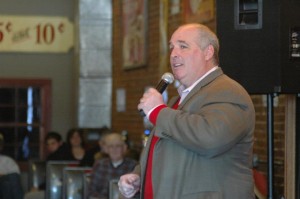
Sen. Tom Rielly at Eggs and Issues where they discussed the proposed 10 cent gas tax increase
Oskaloosa, Iowa – At this point, the CIN (Commercial Industrial Network) has made it’s way through the Iowa Senate and is now headed to the Iowa House where it’s not expected to hit any trouble making it’s way to the Governors desk. “It was high time we got that done”, Tom Rielly (D-Oskaloosa) said of it clearing the Senate.
The additional 100 miles could be an important step in helping to get improvements to highway 63 and ultimately helping to have the pieces in place to attract business to the area.
Iowa Tuition Grant Fund cuts and cuts to community colleges have concerns about not funding allowable growth for Iowa’s public schools. Rielly says that these types of issues have been the topics most brought up to him by his constituents and not 2nd Amendment. Something that drew much attention in the Iowa House this week.
Rielly talked about a flood mitigation program that recently made strides in its progression to law. The program would allow the state to be more prepared in case of disaster such as Cedar Rapids or the Missouri River floods, that impacted the western part of Iowa. “Try to figure out ways, maybe, [to] invest into resources that mitigate flooding and potential for flooding.”
Rielly spoke about a new philosophy in flood control that looks at levy’s along the entire river as adding to flooding problems, versus using natural wetlands as a way to disperse the flood waters.
Rielly’s primary focus this year has been roads and bridges. “I’ve had a lot of people that have come to me and continue to be concerned about the condition of our roads and bridges.”
Rielly says that his gas tax proposal is “floor eligible”, where it passed out of sub-committee and the full committee and is now in Ways and Means committee. “It can stay there until sign and die, and that’s the very last motion.”
Rielly believes that support for the bill has bi-partisan support, “I’ve had just as many republicans, I may have had more republicans say, get this thing done, it’s ridiculous.” He readily admits that passage of the bill is more difficult with the increasing gas prices. “For me, as I’ve said many times before, I’d rather not vote on a gas tax because I don’t want to do this. But that’s not going to fix the bare minimum $220 million dollars of critical needs.”
He goes on to say, “The governor asked for $50 million dollars in efficiencies. They couldn’t even find that this year.”
So I posed the question to Rielly about our neighboring state of Missouri and their seemingly improved road system. “What Missouri does every 10 or 15 years, they do a huge bond. They borrow money. They do a whole bunch of work all at once and then they don’t do anything.”
Rielly said that then paying back those bonds makes it impossible for the state to then do regular maintenance and any money is used to pay off the bonds. “The problem is, they get upside down because they don’t raise their gas tax.”
Looking at other options is something that has been looked at according to Rielly. Things like toll roads are not an option because the revenue generated would only cover the costs of running the toll system, such as payroll of employees. “Plus, when you have a toll system put in place, a majority of Iowans, who are thrifty, would probably avoid the toll road and try to take an alternative route.”
Also looked at are severance taxes. These taxes are not paid by those in the state, but by the consumer of the goods from that state. Example being an oil producing state such as Texas or lumber from the northwest. Ethanol has been considered for such a tax. Rielly points towards a fledgling industry and the possibility that it would make it difficult for the new commodity to gain inroads with the tax increase.