House, Senate GOP find agreement on state budget but not property taxes
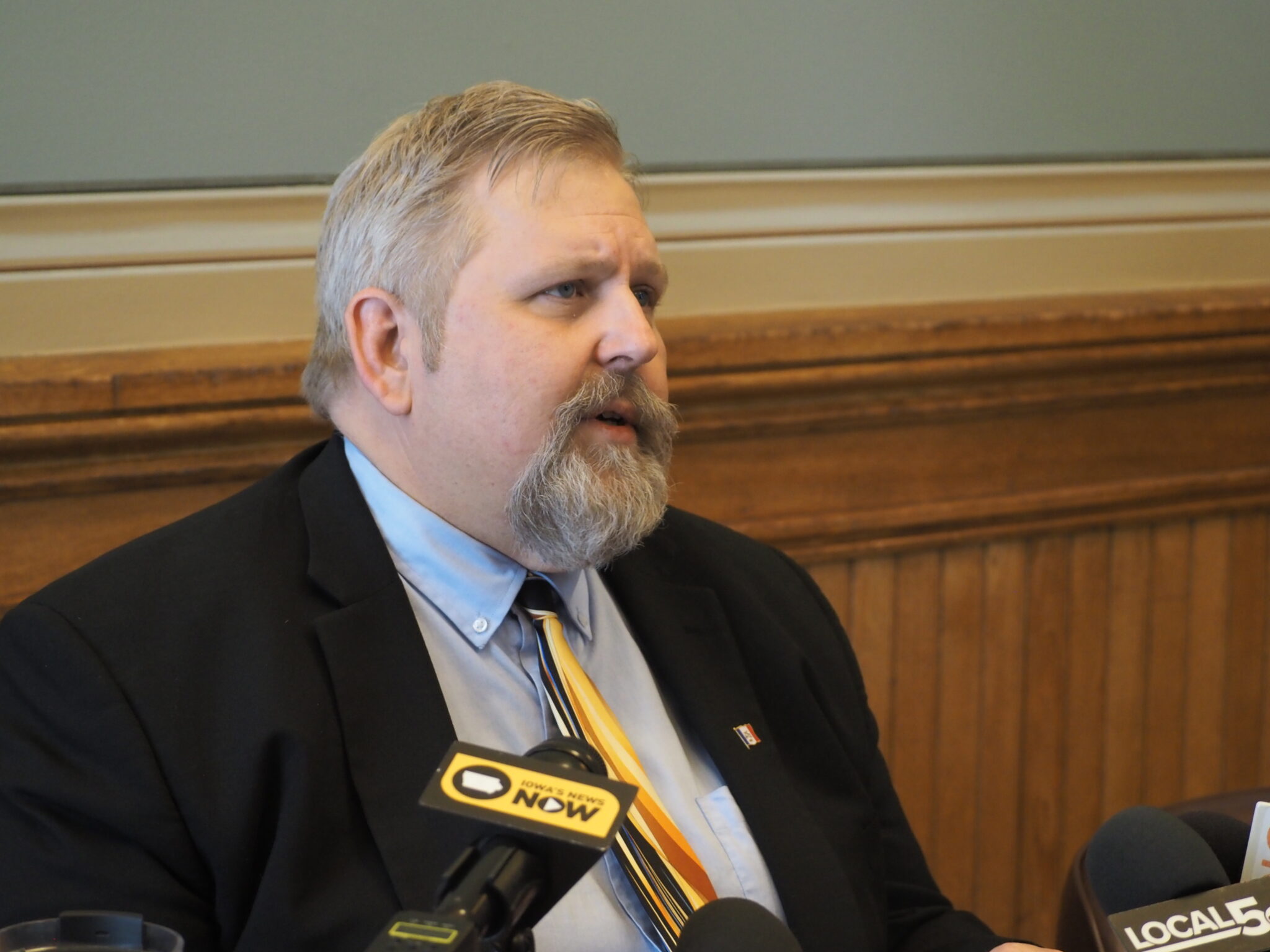
Senate Majority Leader Mike Klimesh answered questions from reporters April 23, 2026 as he shared figures from a budget target agreement between the House and Senate. (Photo by Robin Opsahl/Iowa Capital Dispatch)
by Robin Opsahl, Iowa Capital Dispatch
April 23, 2026
House and Senate Republicans have reached a budget agreement for fiscal year 2027, leaders said Thursday, but have not yet bridged differences on property tax legislation.
Senate Majority Leader Mike Klimesh held a news conference Thursday to share details of a budget target agreement reached between the House and Senate majority parties. Iowa lawmakers passed the 100th day of the legislative session Tuesday, with the budget among major issues to resolve before adjournment.
There is still a slight difference of roughly $3 million between the updated funding goals when comparing the Senate and House proposals. The Senate is aiming for a $9.645 billion budget while the House seeks a $9.438 billion budget. While debates and negotiations on specific line items will continue over the weekend and into the next week, Klimesh said the overall budget compromise has been reached, putting lawmakers “one step closer to getting out of here this year.”
“There are some place card holders in the budget for different initiatives, but again, you know, what will happen now is two appropriation chairs will sit down, they’ll identify these targets, they’ll engage with their budget subcommittee members, will engage with the house counterparts, and those conversations will start to take place more at a granular level,” Klimesh said. “So I think we’ll see more stuff sift out in the next few days as this conversation proceeds.”
The Senate budget target represents a 1.43% increase in spending when compared to the previous year.
Finalizing a budget agreement between the two chambers is a crucial step in ending the legislative session but not the only one legislative leaders hope to complete. Chief among them is finding a compromise on property tax legislation.
The Iowa House passed Senate File 2472 in a 64-23 vote Wednesday, amending the bill to replace its language with that proposed by House Republicans. The language approved by the House has some significant differences in comparison to the language passed by the Senate earlier in April in a bipartisan 41-4 vote.
The House proposed a 2% “hard” cap on local government revenue growth — not allowing for adjustments based on inflation — in addition to working to lower current property tax costs by converting the homestead tax credit to an exemption while tripling its amount of exemptible tax value to $15,000, using the money currently going toward the tax credit to lower the state’s $5.40 uniform levy for school foundation property taxes. It also speeds up moving funding from Secure an Advanced Vision for Education (SAVE) toward property tax relief, sets limits on Tax Increment Financing (TIF) districts and creates a $10 million grant to help local governments pursue consolidation efforts and shared service agreements.
In contrast, the measure passed by the Senate has a “soft” 2% cap, allowing for inflation adjustments, in addition to making changes to the state’s “rollback” system for calculating property taxes and reversing some parts of a 2023 property tax law. The Senate language also proposes adding an inflation index to the Iowa gas tax to go toward road maintenance and repairs, and would reestablish a multi-residential property class distinct from residential properties — two provisions that received some pushback during a House public hearing on the measure.
Klimesh said the two proposals being passed by each chamber helps “at least identify a path we can go down” as legislators look for a compromise.
“Let’s be honest, right? There’s some differences yet,” Klimesh said. “You know, the Senate’s approach has always been to try to find a way to provide property tax relief for homeowners in the state of Iowa. We also understand that Iowa has the worst bridges in the country, our infrastructure dollars aren’t stretching as far as they once did. … I think we’ll spend some time identifying what each chamber really can’t live without, so to speak, in those proposals, and then those anchor points will then be how we build from there and continue the conversation.”
Klimesh said some of the “foundational components” Senate Republicans hope to retain from their proposal are issues like the inflationary adjustment for a local government revenue cap.
“I mean, we feel pretty strongly about a soft cap — or some variation of a soft cap, whatever that conversation looks like,” Klimesh said. “But again, at the end of the day, you know, we’re respectful of the House’s position. We appreciate them putting something forward.”
House Speaker Pat Grassley told reporters House Republicans also feel strongly about keeping the 2% “hard” cap in place from their proposal — though both leaders said they are willing to work toward a compromise.
“We feel pretty strongly about is making sure that if there’s going to be a cap, there are hard caps in the bill, not based on certain inflators and other things,” Grassley said. “I know that’s a disagreement that we have. But, you know, we’d love to have a conversation if maybe there’s a hybrid or a place in which we can negotiate that we’d be happy to do it. But we feel pretty strongly that needs to provide the certainty for the taxpayer. We want to see a pretty static level baseline on that.”
Both Klimesh and Grassley expressed optimism about finding a compromise and sending property tax legislation to the governor before the end of session.
“I think it is a positive step for each chamber to stake their ground, and I think that’s why it was important for us to do that — again, incorporating a lot of ideas from the Senate and the governor in doing that. … That’s why I see it as a positive step: Now both chambers have acted, they’ve established their kind of their baselines of where they need to be, and then we work from there.”
Eminent domain still stalled
Another measure that has yet to reach a consensus is legislation related to the use of eminent domain in carbon capture pipeline projects. The House sent House File 2104, a bill directly banning the use of eminent domain for carbon pipelines, to the Senate in January. This measure was amended during the Senate committee process and replaced with language put forward in legislation from Klimesh originally through Senate File 2067, which allows for the use of eminent domain by hazardous liquid pipeline operators, but restricts its use to after an operator has “diligently exhausted” other possible willing landowner easements within a widened cooridor.
The issue of eminent domain was a point of conflict amongst Senate Republicans in the 2025 legislative session, as a group of 12 Senate Republicans refused to approve budget bills unless eminent domain legislation was brought to a vote in the chamber. The Senate eventually passed a bill on the subject that was vetoed by Reynolds.
Klimesh said Thursday that Sen. Kevin Alons, R-Salix, introduced an amendment to the House bill last week, and that Senate Republicans are now discussing both of the proposed amendments.
Klimesh said “the goal is, and always has been, to find 26 Republicans that can support either proposal or idea.” While he said he would not personally support Alons’ amendment because it did not allow any use of eminent domain for carbon sequestration pipelines, he said he was supportive of the senator’s action to work to find support for his proposal from a majority of Senate Republicans.
The 2025 eminent domain measure did not pass the Senate along party lines, reaching approval with both support and opposition from Republicans. When asked if getting support from a majority of the Senate GOP caucus was needed to bring legislation to the floor, Klimesh said, “Senate Republicans have always taken that approach.”
“We find a path to having an agreement in our caucus to move that policy forward, right?” Klimesh said. “That’s what we do, and that’s what we’re trying to do this year, both Sen. Alons and myself, with our different approaches to amendments, having conversations in our caucus to build that support.
Iowa Capital Dispatch is part of States Newsroom, a nonprofit news network supported by grants and a coalition of donors as a 501c(3) public charity. Iowa Capital Dispatch maintains editorial independence. Contact Editor Kathie Obradovich for questions: info@iowacapitaldispatch.com.