Discussing Education With Governor Branstad
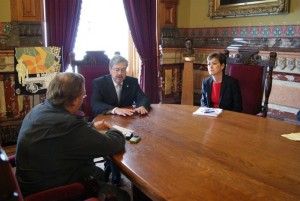
Osky News had an opportunity to sit down with Governor Branstad and Lt. Gov. Kim Reynolds Tuesday afternoon to discuss education reform (photo by Don Hubbard)
Des Moines, Iowa – Education and education reform have been topics at nearly every political roundtable, forum, and listening post on a regular basis for the past several years.
Since taking office in January of 2011, Governor Branstad has been working on one of his campaign promises, which he started in March of 2011 with the announcement of an Education Summit. “Restoring Iowa’s schools to best in the nation status is one of the four major goals of this administration,” said Reynolds in a press release with the announcement of the summit in July of that year at the Iowa Event Center. It further included town hall meetings held across Iowa.
On Monday night, the House played host to every Iowan that was concerned about education and Gov. Branstad spoke at the public hearing on education reform held by the Iowa Legislature. There he said, “Iowa children deserve a world-class education, no matter where they live”… “Our legislative package is ambitious because Iowa has a lot of work to do. Watering it down is not fair to our children.”
On Tuesday afternoon, I sat down with Governor Branstad and talked to him about his education “blueprint” that he and Lt. Gov. Kim Reynolds have been working to develop and have passed and implemented for the past year.
“You know, one of the reasons I ran for governor is I really believe Iowa has been complacent too long in reforming and improving our education process. Historically Iowa’s been a real leader in student achievement. Back in the 90’s on the NAEP [National Assessment of Education Progress] test we lead the nation. Now, on 4th grade reading I think we’re 28th and I think 25th in 8th grade math. So we have slipped. We have basically been stagnant while other states have put in place state standards and effecting assessments. They’ve done things to improve accountability and I just believe it’s time for Iowa to get serious and pass major reforms and then also have the tenacity to also stay with it and continue to improve year after year.”
“It’s a comprehensive plan. First of all, we tried to think this thing through very carefully and I talked about it in the inauguration a year ago. We then had the education summit last summer. We were very open to try and get everybody involved. We had all the education groups, a lot of parents and experts throughout the country, even some international people. We had over 1,600 attend. A lot of good ideas from that. We did survey’s of all the people that attended, came up with our blueprint, and then we did town-hall meetings around the state. We got a lot of feedback and made some adjustments and changes in light of what we heard there. Then we put together our revised blueprint as part of the education reform.”
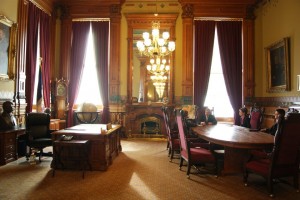
Sitting down with Governor Branstad and Lt. Gov. Kim Reynolds Tuesday in the Governors Formal Office discussing education (photo by Don Hubbard)
Branstad did reiterate his concerns about the plan being watered down saying, “I understand there is resistance to change. People are always fearful of change, especially people that are directly affected. What I find is people hate change, but they love progress.”
“What we need to do is have the courage to make the change, and then I think people will be very glad to see the progress and the improved student achievement and the benefits that will come from it. There is some risk any time you make change, but I think we’ve got to not be so risk inverse that we’re afraid to make bold changes. We’re not asking people to do reckless things, we’re asking people to do things other states have done that have worked.”
The education plan presented by Governor Branstad has met resistance in some areas such as requiring a 3.0 grade point average for a future teacher and annual reviews, so I posed the question if Governor Branstad believed that schools should be evaluating their teachers more.
“Yes, Right now our present law says that for experienced teachers, they’re only evaluated once every three years. I think the benefit of having more regular evaluation makes sense.”
“When I was at Des Moines University, we did annual evaluations. We even went to 360 degree evaluations, where normally the evaluator is the supervisor evaluating the people who report to them. We turned it around and had the people who report to me, as the president of the university, evaluate my performance. I said I’d be the guinea pig. I’ll be the first one to do that because we were looking at going to 360 evaluations for everybody, and I said let’s do that for me first. What I found is, the vice presidents and the deans that reported to me said I gave a lot of positive feedback, but they really wanted more constructive criticism. They said, we want to be held more accountable. As a result of that, it gave me the courage to be a little more forthright in some constructive criticism.”
“I think instead of looking at evaluations on a regular basis or annual basis as being a threat, you got to look at it as an opportunity that, this is a chance I can improve my skills and be a better teacher.”
Competition between schools for students has also been brought up, at many a coffee shop and town hall meeting, as a way to drive up performance by making school systems compete for students and ultimately the tax dollar that is attached to that student. I posed the question to the Governor about vouchers and that possibility.
“I think it makes sense to have some competition. One area, Carroll, Iowa. There’s a very strong Catholic School and a strong public school. Carroll Kuemper and Carroll Public School and they do compete with each other and I think they’re better because of it. So they’re both very good. One of the challenges, I think, is we also need to provide some incentives for teachers to teach at some of the more challenging inner city schools and things like that. So maybe some times we give some financial incentives for really great teachers to take on those kinds of challenges.”
No Child Left Behind is the federal mandate that casts a huge shadow over most public schools, not only in Iowa but those states still under the federal guideline. Iowa is applying for a waiver from the mandate, which has already been granted to 11 other states. Branstad points towards the hurdle of passing education reform before that will be possible.
“It all depends upon how well we do with this education reform. To get the waiver, you have to show that you have your own state accountability system that the US Department of Education feels is adequate to give you the opportunity to be waived out of that ‘one size fits all’ federal system. 11 states have received it so far. We’ve applied, but Jason Glass has basically said that whether or not we get this approved through the legislature is going to determine whether he thinks we’re going to be able to go forward and be successful.”