Guy Vander Linden Capitol News Update March 8, 2012
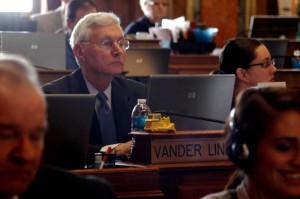
Representative Guy Vander Linden works at his desk in the Iowa House (file photo)
Iowa’s Economic Competitiveness Improves
Iowa’s position amongst states in regards to economic competitiveness improved according to a national study. On Wednesday, the Beacon Hill Institute released its annual survey of state economic competitiveness and rated Iowa as the eighth most competitive state in the nation. This is one step up from the state’s ninth place ranking in 2010.
The Beacon Hill Institute, based at Suffolk University in Boston, has conducted these surveys for eleven years. The survey grades each state on eight topics – government and fiscal policy, security, infrastructure, human resources, technology, business incubation, openness, and environmental policy. The grades for these categories are determined by rankings of 44 separate indicators ranging from the number of active physicians per 100,000 residents to how a state’s budget deficit compares to its gross state product.
Iowa ranked near the top on the state’s minimum wage level, the percent of population enrolled in degree-granting institutions, the budget deficit, murder rate, and average rent for a two-bedroom apartment. Iowa did not do so well when it came to air travel, the number of physicians per 100,000 Iowans, and the number of full-time public employees per 100 residents. Iowa ranked 50th in the number of business “births” per 100,000 Iowans.
For 2011, the survey found that Massachusetts was the most competitive state in the Union. Although Iowa’s rank as eighth is a good sign, there is still a need for more action to improve Iowa’s competitive status. View the full Beacon Hill institute report: http://www.beaconhill.org/Compete11/Compete2011.pdf
Public Hearing on Education Reform
On Tuesday the House held a public hearing on House File 2380, the Education Reform bill. Following an opening statement by Governor Branstad about his proposed bill, the legislature heard from about 44 speakers. Many speakers did not take a firm position on the full bill itself, but rather individual parts of the bill. Speakers included teachers, principals, superintendents, lobbyists, parents, youth ministers, school board members, union representatives, and students.
Among those attending, several speakers focused upon the online learning components in the bill. A parent of several children now enrolled in online learning programs spoke about the positive experience it afforded him and his family. Others were cautious about a full day of online learning for any kids, specifically those in younger grades, and expressed concern regarding socialization and achievement.
Additionally, a provision in the bill regarding third-grade literacy and the retention of third-graders who do not meet minimum proficiency received much attention. Some believed it is unfair to base a child’s progression on a single test.
Others argued that acquiring necessary reading skills was essential to achieving any success in later grades, claiming passing a student along when they were unprepared was not a fair move. While there is agreement that a larger focus on literacy is necessary, the retention part of the bill remains up for debate.
Despite various positions of many speakers, the majority applauded the necessity of some type of reform.
The next step for the Education Reform bill will be House Floor action. Amendments are being drafted and discussed on both sides of the aisle as legislators prepare for upcoming discussion before the full body. The Senate is currently moving its own version of education reform in a much smaller bill that shares some similarities with the governor’s proposal and the bill before the House. When and if they plan to act on their measure remains unclear at this point.
Providing Support for Grieving Families
Each year there are between twenty-five and thirty thousand stillborn babies. In these cases, most states offer a fetal death certificate but oftentimes further recognition of a stillborn child is sought by the parents. This year, Iowa families approached House Republicans and requested the furtherance of legislation that would recognize such children.
House File 2368 is a bill which allows for the issuance of a Certificate of Birth Resulting in Stillbirth.
This certificate may be issued under HF 2368 if a parent requests it and will include the date of the stillbirth, where the stillbirth occurred, and any name (or no name) given to the child. 32 other states have passed similar legislation. The M.I.S.S. Organization and Missingangelsbill.org have worked with families across the country to pass legislation to recognize stillborn babies.
House Republicans and Democrats worked together on this bill to ensure that it met the needs of these families and was practical for departments to implement. The end result was a bill that received unanimous consent in both the Judiciary committee and on the House floor. House File 2368 is now in the Senate awaiting their support.