Weather Spotters Train Once Again To Help Their Neighbors
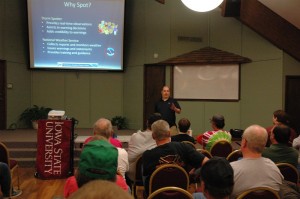
Jim Lee of the National Weather Service in Johnston gives the 2012 storm spotter training course Wednesday night at the ISU Extension office
Oskaloosa, Iowa – Spring brings severe weather to Iowa, and being prepared to help their neighbors drew 68 area residents to the ISU Extension Office in Oskaloosa to learn the skills needed to help identify threatening weather.
Mahaska County Emergency Manager Jamey Robinson was there to help, once again, coordinate the training session. During the years he’s seen attendance grow from less than 20 attendees to a peak of over 100 the year after the Parkersburg Tornado.
Robinson said the reason for holding the class is to help make Mahaska County more ready. “These individuals who attend tonight know what it is they’re looking for; they’re actually issued numbers from the National Weather Service. They can relay that information to the National Weather Service, and that information comes back to us here in the county and we can investigate it.”
Those who attended the training tonight will be better informed to help identify potentially dangerous situations, “It’s not just someone calling from their front porch. It’s someone who’s trained to know what to look for so that information is relayed to the National Weather Service.” Robinson said.
Last year Mahaska County was designated as ‘StormReady’ by the National Weather Service until 2014. Robinson said that getting certified took two and a half years, “It’s just an ongoing process to make sure that we meet the standards the National Weather Service puts out there.”
The designation covers all of Mahaska County. “All the schools, all the city halls, everyone is participating in it. All the cities signed a letter saying they support the StormReady process.”
“The mission of the National Weather Service is to protect the lives and property of the people of the United States. We do everything that we can. Our meteorologists, as dedicated public servants, get out the word on especially hazardous weather, severe thunderstorms, things of that nature.” Jim Lee, meteorologist for the National Weather Service in Johnston, said of the mission given to them.
“At the weather office, we have all sorts of tools, especially Doppler Radar that can help us”, Lee said. “But it’s until we get ground proof and confirmation, you can’t be 100% sure. So if we’re at the office thinking somethings happening and a spotter calls up and says that it is happening”, it adds a great level of confidence in helping to warn others and continue doing their job to protect the public.
In the 51 counties in their district, that covers Central Iowa, the Johnson office has over 3000 spotters and they train nearly 1000 more a year.