Lacey Stadium Seating Capacity To Increase
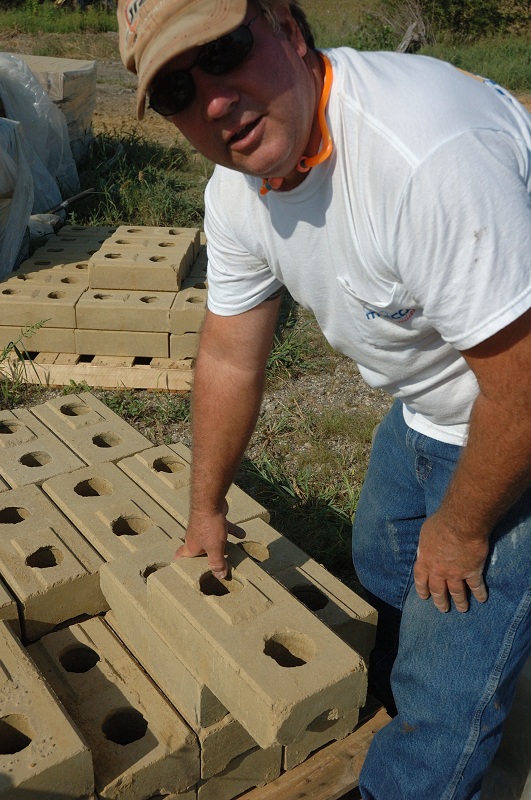
David Stanley of Musco displays some recently made blocks using the Vermeer Block Press. The blocks will be used on terrace seating at the new Community Stadium at the Lacey Complex.
Oskaloosa, Iowa – “One stadium built by many serving more,” is the slogan that adorned t-shirts sold last year in support of the new stadium. Different facets of the community have come together over the past couple of years to help make the project a success. It could be something such as a church group that helps clean the stands or a business that donates its time and technology to helping add a different dimension to the project that might not have even been originally thought of.
Vermeer’s new block-press has been a familiar sight at Lacey this summer, as workers make brick to use at the stadium, and Vermeer has a working model nearby to demonstrate to clients.
Vermeer currently has nearly a half a dozen of the machines out in the world, in places such as Rwanda where Bosco Nkurunziza is helping those back in his native land become familiar with the press. With the new press, workers can make nearly enough brick to build a home in a single day.
Recently, that block-press, manufactured by Vermeer in Pella, Iowa, has been in operation on the grounds at Lacey Complex. It has been squeezing out the bricks that will help make up the new terrace seating at the north end of the stadium. The press that is being used was the prototype of the design that uses materials readily found in most environments and, in this case, it was some clay hauled all the way in from Beacon. Some sand is added to it, then the 25 gallons of the clay-sand mixture is put into a mixer along with 2 gallons of dry cement mixture. They then add some water to the total mixture, where they look for a certain consistency.
The press, made with no electronics or on-board computers, runs on a diesel motor to power the hydraulics. There is no automation on the press, as the operator runs the levers manually.
The press squeezes the material to 1,500 lbs and then releases it. Workers then stack the block, letting them cure for 7 days before they are ready to use. This gives the cement a chance to hydrate and develop some strength.
Once cured, the new blocks are reportedly impervious to water, and can stand up to most anything mother nature has to offer.
The blocks are keyed to allow the blocks to lock together, making it possible for those with limited construction experience to stack the block. In the center of the block are two holes, this not only allows the block to be lighter, but enables the press to generate more pressure during the manufacturing process. These holes also allow for reinforcing steel bar to be placed inside the hole and in conjunction with cement poured into the holes, helps make a stronger structure.
Currently, the team from Musco that has been using the press has made nearly 5000 bricks already, “We’re just making a few extra here,” says David Stanley of Musco, who has been overseeing the brick making process for the stadium.
The current plan has 100 feet of terrace seating being built at the north end of the field. Eventually it’s thought that more will be added, wrapping it on around the north end, once time and money becomes available.