Downtown Historic Marker Program – Mahaska County Courthouse
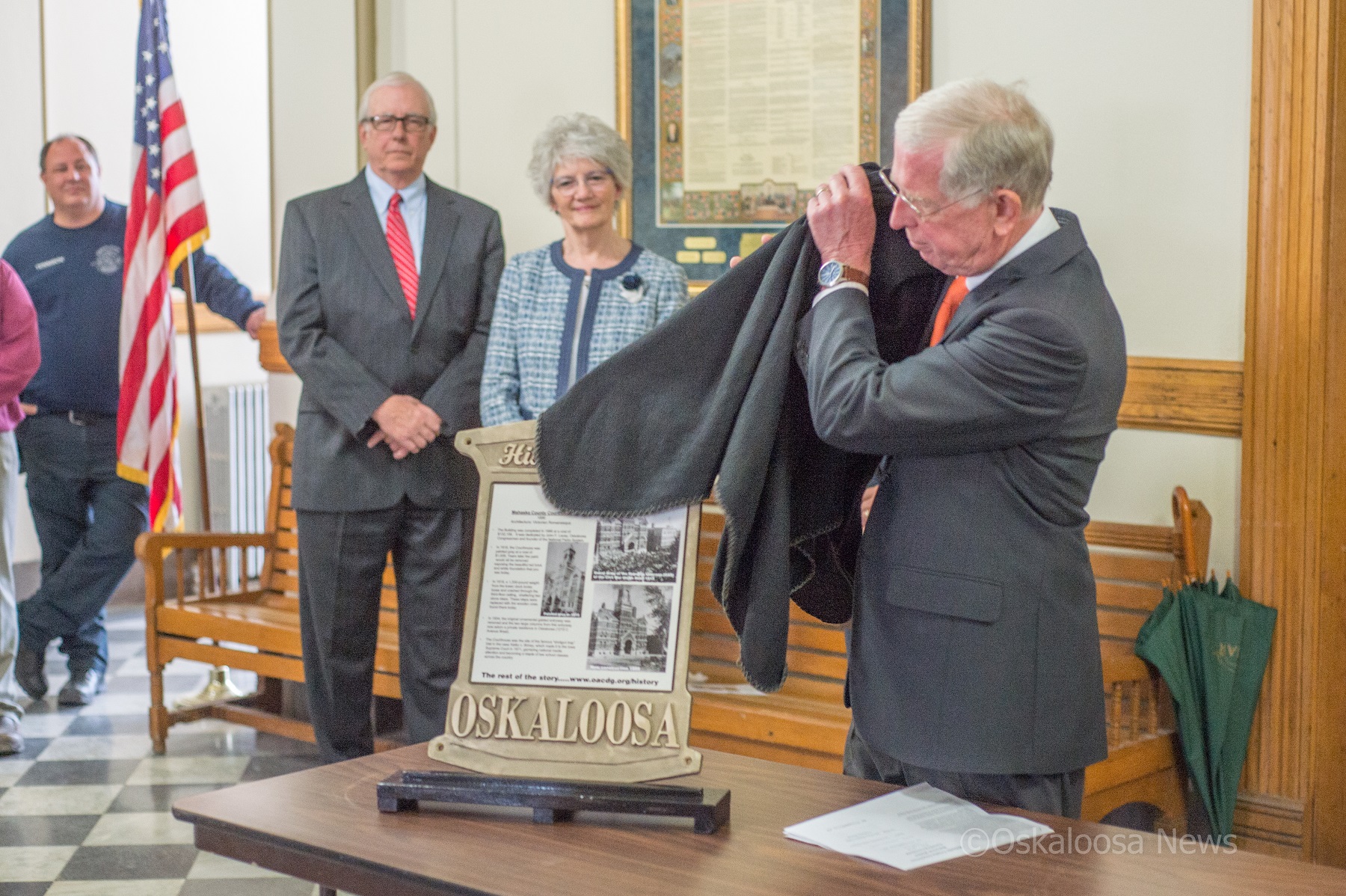
Dave Dixon uncovers the historical marker for the Mahaska County Courthouse.
Oskaloosa, Iowa – The downtown historic marker project inducted its second building this past week when dignitaries and the public gathered at the Mahaska County Courthouse.
According to committee member Ann Brouwer, the project is made possible by the volunteer efforts of many people and businesses throughout the community. Eight downtown buildings will be recognized during the initial phase of the project.
The first marker was placed at the Oskaloosa Fire Station on February 15, 2018.
The title information, plaque construction, and design, as well as installation, are all made possible by generous donations from area businesses and individuals. The generosity of those involved has driven the cost down to approximately $100 per marker, from the approximate $1000 cost originally projected.
Oskaloosa attorney Dave Dixon was the main researcher for the courthouse. Dixon dug into the design, construction, and alterations that have taken place to the structure over its lifetime.
Stories from past and present officials and employees recount many stories of days gone by in the Mahaska County Courthouse, including a man that, several years ago, paid his taxes all in loose pennies.
Other stories spoke about how officials have helped to watch over renovations and help preserve the past while being able to serve the future. Some of those people leading that were Mary Sexton and Jim Blomgren, in regards to the courtroom and those facilities.
Oskaloosa Mayor Dave Krutzfeldt spoke at the unveiling, stating, “As we look around the community and the beauty of the architecture, you can’t help but be awed by the designs that have withstood the test of time.”
“They were designed by people with the intention that they [the structures] would outlive them,” added Krutzfeldt.
Krutzfeldt praised the design and function of the building. “It was built with an elegance that we never grow tired of seeing.”
“So we step back, and we look at the quiet elegance of this building,” said Krutzfeldt of the Mahaska County Courthouse. Speaking of the majestic interior and exterior of the building, Krutzfeldt noted the west steps of the structure. “That elevates this building off of the sidewalk, helping the person who enters the building to understand that they are going to an elevated purpose.”
“I’ve heard it said that first you control the creation of a building, but after that, the building controls you,” said Krutzfeldt. “Buildings like this inspire to understand the importance of the matters that are being dealt with here, sometimes on a daily basis. And we are influenced by the building to conduct ourselves accordingly.”
Dixon spoke last about the history of the Mahaska County Courthouse.
Noting the dedication plaque on the floor of the courthouse of 1886.
Dixon has lived in Oskaloosa for approximately 40 years. “During the time I’ve been here, I’ve become a keen student of Oskaloosa history, and I enjoy it tremendously.”
“It’s been very interesting to read and study about the courthouse,” said Dixon. “I’ve been very fortunate because there’s a lot [of history] that has been put together and written about the courthouse in the past.”
Dixon said it was designed in Romanesque architecture, with a Victorian twist.
Gone today is the ornate gabled porch on the front of the courthouse which was removed in 1934. With those were two large columns that have since been removed, and are now located on the front of a home along the 1200 block of C Avenue East.
Also missing now from the original courthouse are two large chimney’s, one on each side of the structure. The clock tower also used to have a cap, which added height to the structure. The cap was also removed in 1934.
It’s unknown when the chimneys were removed from the structure, and best estimates put the time frame to when the building was converted to steam heat.
The courthouse was also painted a light gray in 1916. There was never an indication in the research as to why the building was painted.
It cost $1009 and took four men about 20 days to paint the structure.
Dixon shared the story he found most fascinating of the courthouse, which took place just over 100 years ago.
“In March of 1918, the large weights that they had for the clock, one of them broke loose and crashed through the ceiling,” said Dixon.
The weight that crashed through the floor was approximately 1200 pounds and was about 50 foot over the clock tower floor. The weight then crashed through the cement floor and fell down further into the courthouse.
Today, evidence of that accident are visible on the stairs between the second and third floor. Two wooden steps have replaced the stone steps, that were originally there, after the weight crashed into them.
You can read more by visiting the Historic Marker website – https://www.oacdg.org/history/courthouse/