Budget And School Funding High On Legislative Radar
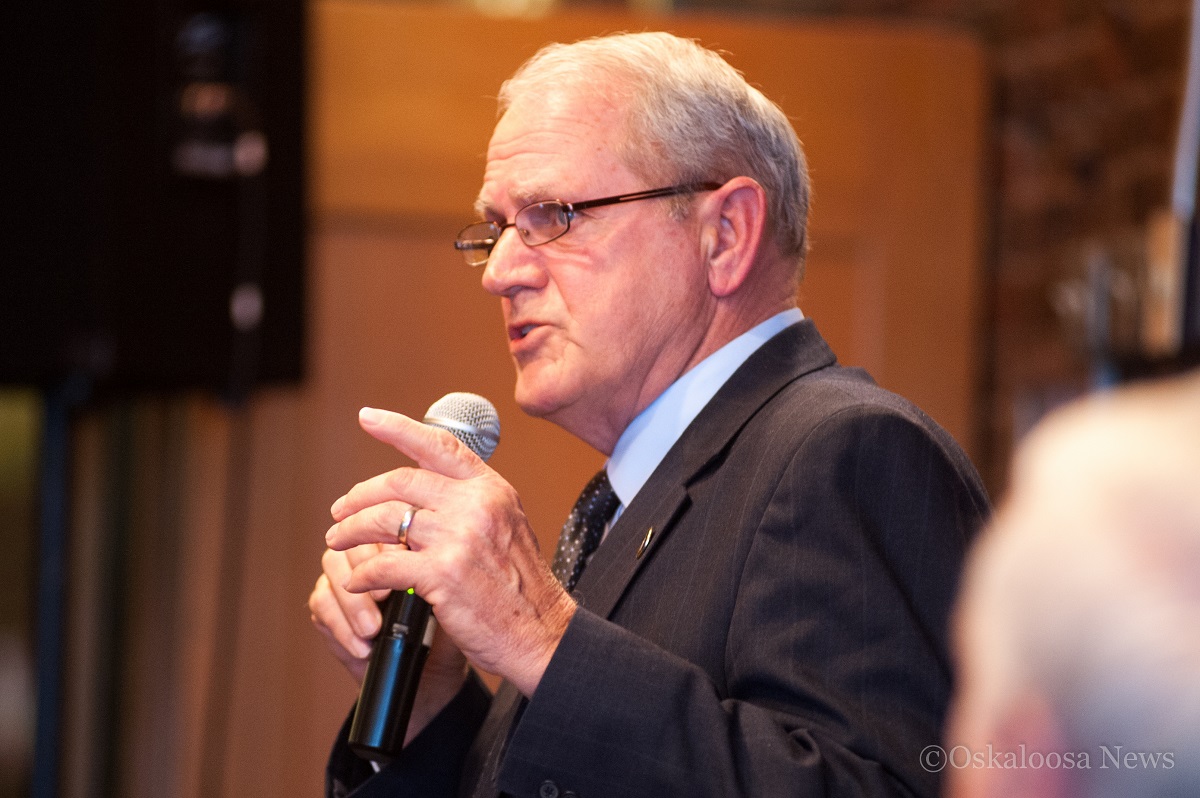
Iowa Senator Ken Rozenboom (R)
Oskaloosa, Iowa – The 2016 Iowa legislative session will be getting underway on January 11th.
Iowa Senator Ken Rozenboom of Iowa Senate District 40, which includes Oskaloosa, will be in the 4th year of his first term. Senator Rozenboom sat down with Oskaloosa News to talk about the upcoming session.
Rozenboom said that for Iowa Senate Republicans, budget issues and school funding will be big issues this coming session. The concern raised by Rozenboom is, as he describes, a dwindling ending fund balance that was once 927 million dollars. “Here three years later, that 927 million is down to 180 million, and dropping like a rock because we have been consistently spending more money than we’ve been taking in.”
“That 180 million disappears in the flash of an eye with some built-in increases that we already know are out there,” explained Rozenboom. “We just don’t have any more budget surplus to keep falling back on.”
Funding education in Iowa will be a big part of the discussion, and it’s impact on the Iowa budget, as funding for the 2016-17 School year has not yet been set.
During last year’s session the Iowa House passed a 1.25% increase in school funding, that was supplemented with 55.7 million dollars in one-time spending. That made the overall increase 2.62%. Iowa Governor Branstad vetoed the one-time money when the bill landed on his desk.
Rozenboom said that if legislation passed by the Iowa House last year were to be passed by the Iowa Senate it would set the rate, for what is known as allowable growth, at 2% for the 2016-17 school year. “Schools wanting to know their funding could have been decided almost a year ago,” says Rozenboom. “That bill, since we’re in the second year of a session, that bill is alive and well and sits on Mike Gronstal’s desk.”
Rozenboom said that the school funding debate “could be taken off the table immediately with a 2% increase in supplemental state aid. It would be a done deal, and schools would know what they have coming.”
Iowa School Administrators say that, “Due to extremely low levels of funding growth, school districts in Iowa are under tremendous financial strain. For 2016-17 and 2017-18 we support a minimum growth rate of 4 percent.”
In Iowa, nearly 55% of all money in tax revenue is used for education.
When education funding is debated this session, eyes will be on that declining fund balance, along with an economy that is less robust than last year, in particular the ag economy which once helped to carry the state, but is nearly stalled. Those decreases in revenues may cause budget projections to decrease, putting that percentage increase once again front and center.
As cities prepare their budgets, the topic of property tax reform and its impact on city budgets is being heard at city halls around the state, as those budgets were tightened by the legislative move.
We asked Rozenboom about that change and if he sees any changes in the near future to property tax reform. “I don’t know if there’s any move to reconsider.”
“Lets not lose sight of the original reason for addressing property tax.” Rozenboom explained that property taxes were increasing at rates higher than what the private sector was.”
Rozenboom said that the formula for calculating property tax was established nearly 4 decades ago, and after time, “some inequities were showing up.”
Residential and farms were indexed together “and could grow now more than 4% each year.”
Those rates are now set at 3% says Rozenboom, “which is still faster than most people’s pocket books are growing.”
“It was a reasonable thing to limit that growth,” added Rozenboom.
“I recognize we reduced the inflow into city coffers. What gets lost in the discussion, at this point in time, is there had been steady and regular growth in that over time. Again, faster than those in the private sector,” said Rozenboom.
Rozenboom said he believes the discussion on Medicaid reform in the state will be hotly debated this session as well.
“We’re going to hear a lot about Planned Parenthood because of their shenanigans with fetal tissue transfer,” said Rozenboom, who is introducing legislation, to have put into the Iowa Code, to prohibit the sale or transfer of fetal tissue or organs for any reason with or without compensation.
Rozenboom said that during the discussion about fetal tissue laws in the State of Iowa, that “Iowa Code does not speak to the issue of fetal tissue transfer.”
“The only laws that apply are federal laws, and they have some of the loopholes that were exploited by Planned Parenthood,” added Rozenboom.
“I believe that Iowa Code should reflect Iowa’s values with respect to fetal tissue transfer.” Rozenboom added, “I will be seeking co-sponsors and submitting it soon.”