Impact in Iowa Helps Raise Leader Dogs For The Blind
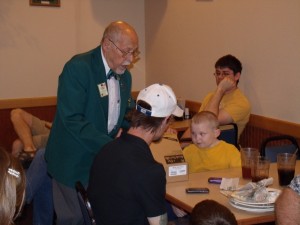
Tommy Tucker, Past District Governor for the Lions Club of Iowa and a member of the Iowa Lions Foundation, presents Matthew with a Book Port Plus electronic book reader at the recent Oskaloosa Lions Club meeting.
Oskaloosa- The local Lions Club of Oskaloosa played host to Impact in Iowa on Tuesday, April 12th. With great regret I had to leave this meeting early in order to cover events that were taking place at Cargill at the time. I want to say thank you very much to the Oskaloosa Lions for inviting me to take part in that evenings events. Some of you may be aware that I am a low vision person, also known as legally blind, and the wonderful work that the Lions, and others like them, do to help people with vision problems overcome obstacles is very important to me, personally.
The local chapter of the Lions Club is just over a year old, and they continue to make a difference in Oskaloosa and to its residents. Their meeting on April 12th, at the local Pizza Ranch, shows how strong the local Lions Club has become in the past year and the good they are doing in the lives of those with vision problems.
Carol Ann, who is with Impact in Iowa and is a volunteer puppy raiser, was on hand with another puppy raiser to give information on how this project started in Iowa. Carol Ann is now working with her 14th dog that will be presented to Leader Dogs.
A puppy is adopted by a family for a year. The pup is usually seven to nine weeks old when sent to the host family. The family raises it for the first year, then the family returns the dog to Rochester Hills, Michigan where Leader Dogs for the Blind is located.
When Carol Ann and her husband started raising dogs in Iowa for Leader Dogs, they were the only couple doing so. They are now “puppy counselors” for Leader Dogs here in Iowa. When this happened, they had 3 others helping to raise puppies as well.
Carol Ann took the project into the Rockwell City prison. For the past 10 years, inmates have been raising puppies for Leader Dogs, with puppy graduation rates of 90%. Carol Ann says that her graduation rate is around 60% and that is a very good rate in itself, but 90% is unheard of. Carol Ann says that the success for Rockwell City is that the inmates have the time, the energy, and a desire to want to give back, “and they do a very very nice job of it” says Carol.
At Rockwell City, they have had a maximum of 22 to 25 dogs there at any one time. That number is currently down to 15 as that ended up being a good amount that the facility could handle. But with that decline came an opportunity for the Newton Correctional Facility, where they have currently added 10 more dogs to the program at their facility for the past 2 years. The Newton facility started with ARL dogs (animal rescue league) to help give the dogs a chance to be adoptable.
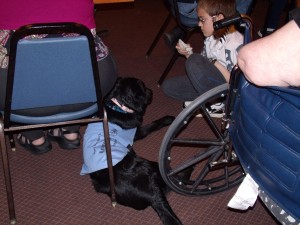
One of the two puppies in training for Leader Dogs that was on hand at the latest Oskaloosa Lions Club meeting.
Leader Dog accepted one of their ARL dogs after only being at the Newton facility for 4 weeks, and he was nick named “Mad Max”. Unfortunately, “Mad Max” did not become a Leader Dog as some hip issues kept him from being 100% medically. But ultimately, ARL dogs have found their way from the Newton facility to Leader Dogs and some are now in class with a blind person. Newton’s program also yielded a “Daddy Dog”, with Leader Dog pulling 2 of the best candidates a year for this. Only the best of the best make this cut. Even though it disappointed those that helped to raise this dog to help a blind person, the dog’s contributions will ultimately help hundreds in the end.
Recently, when some things changed at Rockwell City’s facility, the warden moved from that facility to the Fort Dodge facility. There were setbacks after some prisoners were transferred around and also ended up at the Fort Dodge facility. Over time, many of those “lifers” that had experience with Leader Dogs in Rockwell City started moving to the Fort Dodge facility, and they now have 22 dogs there for Leader Dogs. With all 3 facilities, the Impact in Iowa team has nearly 100 inmates in class helping with this program.
This program not only helps blind people, but it’s helping in the prisons as well. Many times you will see acts of violence drop, and the inmates, that have taken on the responsibility of helping with the program, not getting into trouble in prison because they want to be able to keep working with the dogs. “It does a lot of good” says Carol Ann.
At any one time, Leader Dogs for the Blind will have between 300 to 500 puppies out with families for that initial year. In order to graduate a blind person and the dog, about 500 dogs a year is needed in order to graduate 300. The classes go all year round at Leader Dog, with new students being paired with a dog for the last 28 days of the dogs training. For a returning student, 21 days is normal for pairing and relearning before graduation.
Leader Dogs for the Blind will then do the actual “curb work” and training of the dog at that point, so a blind or legally blind person would then have the opportunity of adopting this dog to help them in their daily lives. Leader Dogs also has the capability to train their dogs to assist those that are deaf/blind. In this case the dog would learn to understand sign language as well.
This training takes 4 months. So the dog at this point, 16 months of age, will be charged with helping to keep the blind, or blind/deaf person safe from harm, and to help them lead a happy and productive life.
The dogs know what their job is, and they live to work and serve. When the dog has their bandanna on, they know they are there to work and serve, and that is what makes the dog happiest. Carol Ann says, “It’s just amazing to me that in 4 months, they learn everything they need to learn. They have to learn obedience to do what their person says, but they also have to learn to disobey.” The reason for disobeying would be to help protect the person from being harmed, such as blocking the person from entering a street when an oncoming car is approaching. The dog will block the person, even while being commanded “forward”.”
Leader Dogs charges the blind person nothing for the dog, or the training required. The actual cost of raising and training the dog for the project is about $39,000, to put the dog and the team on the street. That total does not include the first year of the dogs life when a family donates itself to raising a dog for this purpose. The host family for the dog’s first year donates everything, vet visits, food, everything.
If you would like more information, I have put some links of interest at the bottom of this story. I would personally encourage you to stop and talk with Debbie Doty, or call her about joining or helping out the Oskaloosa Lions Club. You can telephone her at (641) 673-4173.
External Links of Interest from this story:
Impact in Iowa
Book Port Plus
Leader Dogs for the Blind