Researchers connect environmental issues with cancer rates in new report
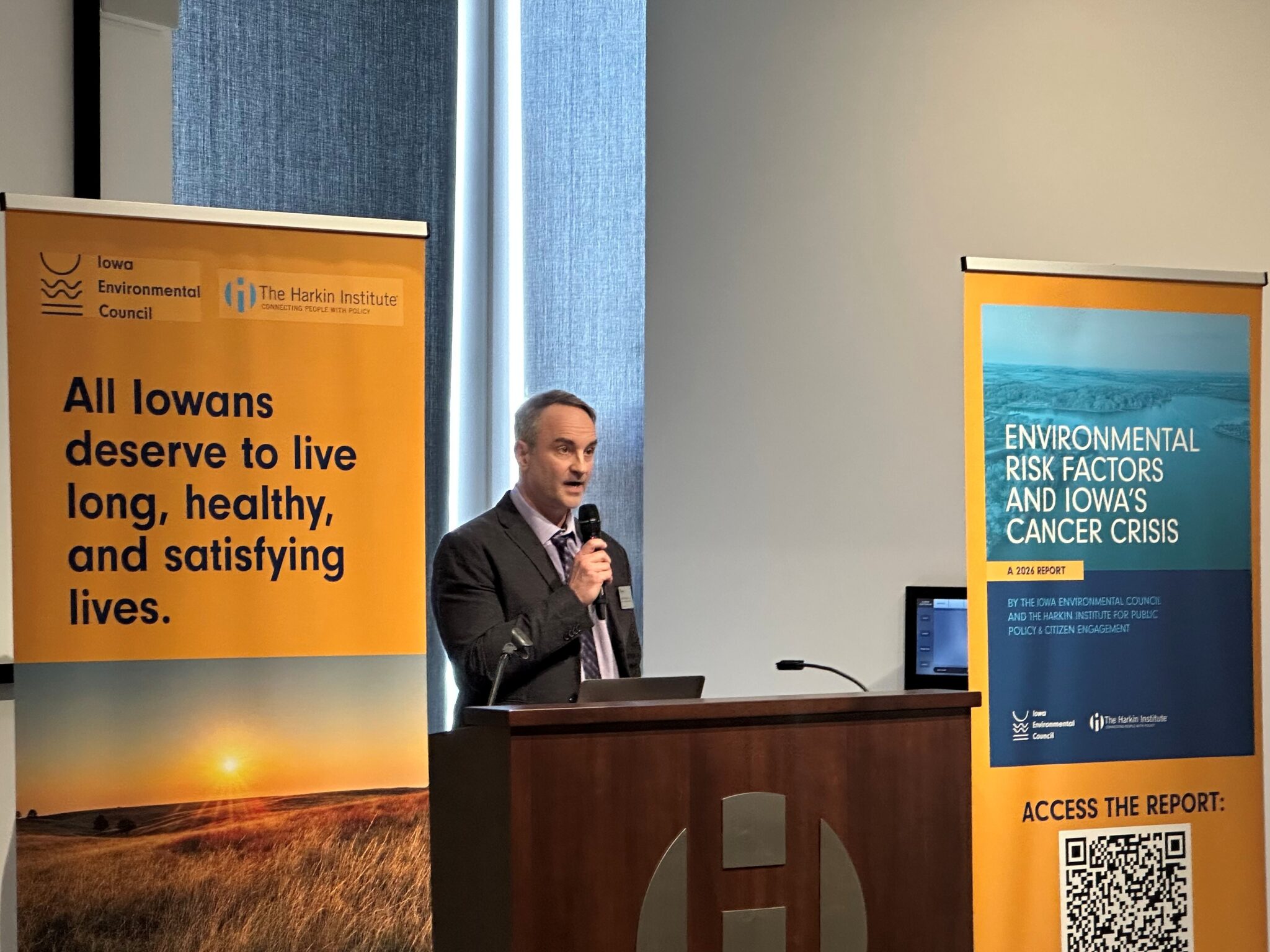
Harkin Institute Wellness and Nutrition Policy Director Adam Shriver speaks during a press conference March 25, 2026, about a report released by the institute and the Iowa Environmental Council on Iowa’s cancer rates and risks. (Photo by Brooklyn Draisey/Iowa Capital Dispatch)
by Brooklyn Draisey, Iowa Capital Dispatch
March 25, 2026
Researchers and public health experts are urging lawmakers to turn knowledge of Iowa’s cancer crisis into action, with a new report detailing Iowans’ risks of exposure to different carcinogens and offering first and future steps to mitigating dangers.
The Harkin Institute for Public Policy and Citizen Engagement and the Iowa Environmental Council released a report Wednesday into the environmental factors impacting Iowa’s high — and rising — cancer rates, including pesticides, per- or polyfluoroalkyl substances (PFAS), nitrate and radon.
Presenters said during a news conference the report goes beyond the topics seeing the greater focus, like personal behaviors and decisions leading to greater cancer risks, and filling the gaps in knowledge that have stopped forward momentum before now.
“Here’s the bottom line — Iowa’s cancer crisis is not inevitable. We can do better, and we must,” said Sarah Green, executive director of the Iowa Environmental Council, during the press conference. “Yes, individual choices matter, but the responsibility cannot fall on Iowans alone. This is a moment for leadership, a moment for policymakers to act with urgency to prioritize prevention, strengthen protections and reduce the environmental risks that are making people sick, because the cost of an action is measured in lives, and Iowans have waited long enough.”
Iowans’ interest drives information synthesis
Harkin Institute Wellness and Nutrition Policy Director Adam Shriver said in an interview it was a conference on public health and agriculture hosted by the institute more than a year ago that launched this collaboration with the Iowa Environmental Council.
After concerned citizens and donors approached both the Harkin Institute and Iowa Environmental Council about the state’s cancer levels, Shriver said the two organizations decided to team up and take a “deep dive” into the topic.
Colleen Fowle, water program director at the Iowa Environmental Council, said in an interview people pointed out that while lifestyle factors were part of discussions on Iowa’s cancer rates, environmental risk factors were “left out of the equation.”
Iowa has held the rank of second-highest cancer rates in the country for three years now, Shriver said, and is one of only two states where cancer rates are rising rather than falling. Richard Deming, an oncologist and founder of nonprofit Above + Beyond Cancer, said during the press conference cancer is the second-leading cause of death in Iowa, and lung cancer alone causes 1 in 4 cancer deaths in the state.
“I think that’s what really spurred on so many people in the community to feel like someone needs to take a closer look at what’s really unique about Iowa and what makes us different from what’s happening elsewhere in the country,” Shriver said.
While this report is not connected to work being done in the Key Drivers of Cancer in Iowa Project, led by the University of Iowa and supported by the state government, it does reference the project’s interim report released in February. The interim report stated that “while demographic characteristics and behavioral risk factors explain a large proportion of Iowa’s high cancer incidence rate, there are still other factors contributing to the higher rates of these cancers observed in Iowa.”
Report finds environmental cancer connections
According to the report, the five most common cancers in Iowa — breast, prostate, lung, colorectal and skin melanoma — have connections to the environmental risk factors detailed in the report. A majority of the cancer types associated with pesticides, PFAS, nitrate or radon are also seeing increases in Iowa.
Iowa is “on the high end” of every one of the exposures in the report, Fowle said, confirmed by Iowa Environmental Council Senior Director of Policy and Programs Kerri Johannsen during the press conference.
Iowa has more than 4,000 concentrated animal feeding operations, which is about 2.5 times the number in the next-highest state. The Des Moines and Raccoon rivers are among the top 1% of U.S. rivers for nitrate concentration, 80% of which comes from agricultural sources. PFAS have also been found in 94% of Iowa surface waters and in 30% of groundwater sources, the report stated.
The state is also an outlier for its use of pesticides, the three most popular identified in the report as glyphosate, acetochlor and atrazine. The pesticides are associated with higher risks of developing bile duct, bladder, breast, colorectal, kidney, lung, ovarian, pancreatic and pharyngeal cancers, as well as non-Hodgkin lymphoma and leukemia. A recent report from Food & Water Watch found that a majority of the counties in the top 20% for glyphosate application have higher non-Hodgkin lymphoma rates than the national average.
Johannsen said both acetochlor and atrazine have been banned in the European Union but see the highest use in Iowa out of all U.S. states, and “pound for pound, the amount of glyphosate applied in Iowa is the highest of any pesticide applied in any state.”
“We’re really being exposed to a cocktail of pollutants, which then it just creates a whole other level of complication,” Fowle said. “If we know there’s some associations with an individual pollutant, that’s concerning, but the fact that Iowans are exposed to multiple pollutants that have association with cancer, it just becomes so much more complex and concerning.”
Forging further protections
Johannsen said during the press conference recommendations from the report range from enforcing laws already on the books, like federal drinking water regulations, to solidifying funding for natural resources and environmental monitoring and using resources to tackle the amount of chemicals used in the state.
Many of the recommendations require collaboration between the Legislature, state and federal agencies, universities and foundations. Personal actions individuals can take to mitigate their risks are also included in the report.
“In order for there to be lasting and durable change, what we need is for more people to come to the table for that discussion about the solutions. We need solutions that are going to work for the people who know the environment and the people who know the public health and the people who know about agriculture and those processes,” Johannsen said. “So we hope this is a starting point and a menu of things that can be the subject of a deeper conversation between everybody involved.”
While presenters said they appreciate efforts at the Statehouse to pass legislation on mitigating radon in new Iowa homes, they’re disappointed to see moves from lawmakers that would lead to less action from the state instead of the more action the public wants to see, such as shielding companies from liability relating to illnesses caused by their products and refusing to fund water quality tracking across Iowa.
Shriver said during the press conference that for the people who say there still needs to be more understanding of the problems surrounding cancer rates in Iowa, this report provides all the facts they could need. He also finds it interesting that the people who say they need more information on the topic aren’t trying to save the water quality monitoring system that currently provides necessary data.
“There’s a little bit of a discord in my mind between this idea that we don’t fully understand the problem, but also doing steps that are kind of actively going backwards in terms of … the amount of information we have available,” Shriver said.
Matt Russell, executive director of the Iowa Farmers Union, also spoke during the press conference, saying that the organization has been part of the process to create the report and continues to participate in these efforts because its members face the same risks as other Iowans.
While the Farmers Union supports use of pesticides and fertilizer and is not against animal, crop and biofuel production, Russell said “it’s clear that we need to change” and the whole state needs to come together to make those changes.
With the report public, Fowle said people should expect to see more from the organizations in the form of a website showcasing the people and stories the research team gathered during listening sessions held in 2025. The original plan was to combine the information they synthesized from existing research and literature with results from the listening sessions, but Fowle said the amount of information they had and the fact that a report wasn’t the best way to share Iowans’ stories led to the split.
The listening sessions also helped guide which sections to include in the released report, Fowle said. It was also announced during the press conference that those involved in the report will hit the road again this year to talk to Iowans about what they should do next.
“I think there is an important tie in, in that everywhere we went in Iowa, people expressed concern about agricultural exposures and drinking water,” Shriver said. “And I think the findings of this peer-reviewed literature that we looked at really reinforced that people were right to be concerned about those issues.”
Iowa Capital Dispatch is part of States Newsroom, a nonprofit news network supported by grants and a coalition of donors as a 501c(3) public charity. Iowa Capital Dispatch maintains editorial independence. Contact Editor Kathie Obradovich for questions: info@iowacapitaldispatch.com.