Iowa becomes the first state to gain more control over federal education dollars
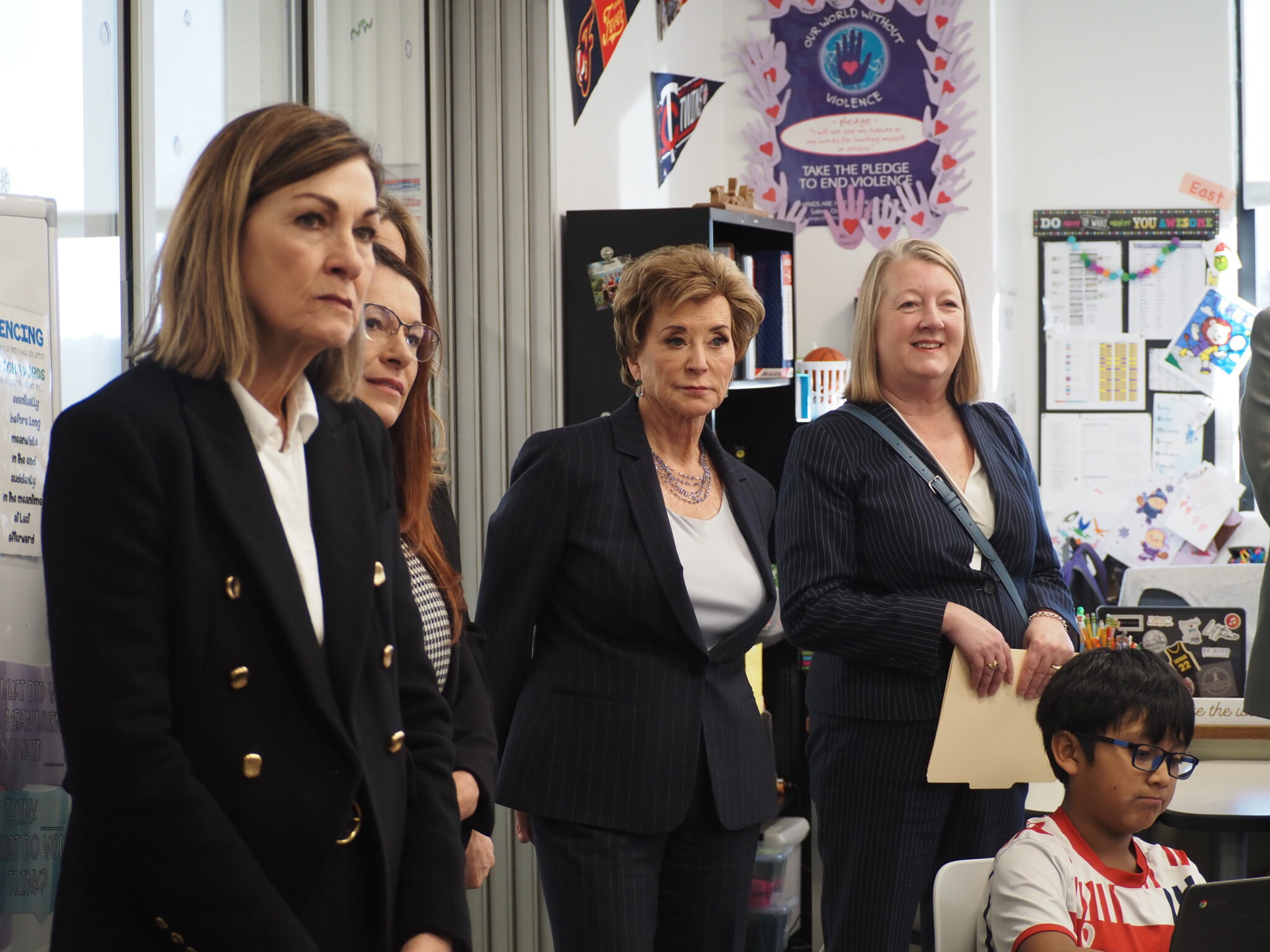
Gov. Kim Reynolds, left, and U.S. Education Secretary Linda McMahon, center, as well as Denison Community School District Superintendent Kim Buryanek, right, listened in on a class at Broadway Elementary School in Denison Jan. 7, 2026. (Photo by Robin Opsahl/Iowa Capital Dispatch)
by Robin Opsahl, Iowa Capital Dispatch
January 7, 2026
DENISON — U.S. Secretary of Education Linda McMahon announced Wednesday in Denison that Iowa was the first state approved for a Returning Education to the States waiver, giving the state more control over nearly $9.5 million in federal education funding over the next four years.
“We know that (one size fits all) mandates fail,” McMahon said. “States should lead. Washington should support their sound approaches and get out of the way. That’s why the Trump administration is granting Iowa this flexibility. And we hope that as we partner with congressional leaders to return education to the states, we can work with them to expand these opportunities for states and local leaders to run their education systems.”
Iowa had submitted a waiver in March to receive nearly $157 million in federal education funding through block grants that would have allowed the state to allocate this funding outside of federal Elementary and Secondary Education Act (ESEA) requirements. While the approved waiver covered a much smaller portion of federal education funding, Gov. Kim Reynolds said the “Returning Education to the States” waiver is the “first step” toward implementing the larger plan.
McMahon had requested in 2025 that states submit applications for waivers allowing more flexibility in federal education spending, and Iowa was the first state to apply for the spending rules exemption.
Iowa’s proposed “unified allocation plan” proposed giving the state the ability to more effectively address education needs in the state and reduce administrative costs, Reynolds argued in September, and said state testing scores show Iowa’s education system was in a good place to take on these funds with less federal regulation.
The waiver announced Wednesday has a much smaller scope than the state’s initial proposal, making changes to reporting and spending requirements in three areas, state Education Secretary McKenzie Snow said.
Four ESEA federal educational funds — Title II Part A, dealing with professional development, Title III Part A dealing with English language learning , and Title IV, Parts A and B covering student support and community learning centers — are consolidated into a single. state-level block grant. This block grant, which totaled roughly $3.8 million for federal fiscal years 2024 and 2025, is proposed to go toward funding professional development for the state’s “science of reading” approach to literacy development as well as for providing all teachers professional development courts on teaching English language learners.
McMahon said a majority of the funding through this $9.5 million block grant is currently going toward complying with federal regulations, according to state estimates.
“If we were operating under the old rules, it would take — according to the figures that were done in the state — about $8 million to comply with the regulation of this $9.5 million dollar grant,” McMahon said. “So in essence, you get about a million-and-a-half dollars to go to the schools. With this new waiver, that $8 million will go to the schools. That’s a big number.”
The proposal also “streamlines” certain reporting and compliance processes, which the officials said will open up both time and money currently being spent by schools and the state on following federal regulations. Additionally, the waiver allows the Iowa Department of Education to give local school districts that receive federal funding from these pools “targeted local flexibilities” in how this money is spent, Snow said.
This will provide school districts, especially smaller, rural districts, the ability to “purposefully plan” their spending and invest in higher quality instructional material, more intensive tutoring options and other needed education supports, officials said.
McMahon made the announcement during a visit to Iowa Wednesday, joined by Reynolds and Snow. The group toured classrooms of Broadway Elementary School alongside local school officials, including Denison Schleswig Community School District Superintendent Kim Buryanek. The Denison elementary school is a dual language school, and the officials went to classrooms where students were learning both English and Spanish, as well as STEM and language arts classes.
Reynolds said the Denison school showcases the importance of investments in English learning and “science of reading” instruction. A 2024 law that focused on bringing K-6 students not reading at grade-level proficiency up to literacy benchmarks resulted in increased third-grade literacy rates statewide, Reynolds said. She cited an “especially inspiring” jump from 65% to 72% at Broadway Elementary School.
“That is a 7% increase, and that number continues to rise,” Reynolds said. “It shows the power of evidence-based instruction in schools, and school districts’ commitment to it. All the K- through 5th-grade teachers in Denison are completing their second year of letters training in the ‘science of reading,’ and fully embrace this approach.
“Our progress also says a lot about Iowa, about the dedication of our teachers and administrators, their collaboration with the Iowa Department of Education and our family’s engagement and student success,” Reynolds added. “But these improvements shouldn’t be limited to the state level, and that’s why I really appreciate that Secretary McMahon and her team are focused on supporting the right work. Work like the science of reading and work-based learning, which truly makes a difference for our students.”
Iowa Capital Dispatch is part of States Newsroom, a nonprofit news network supported by grants and a coalition of donors as a 501c(3) public charity. Iowa Capital Dispatch maintains editorial independence. Contact Editor Kathie Obradovich for questions: info@iowacapitaldispatch.com.