Trump signs order to loosen federal restrictions on marijuana, but it’s still illegal
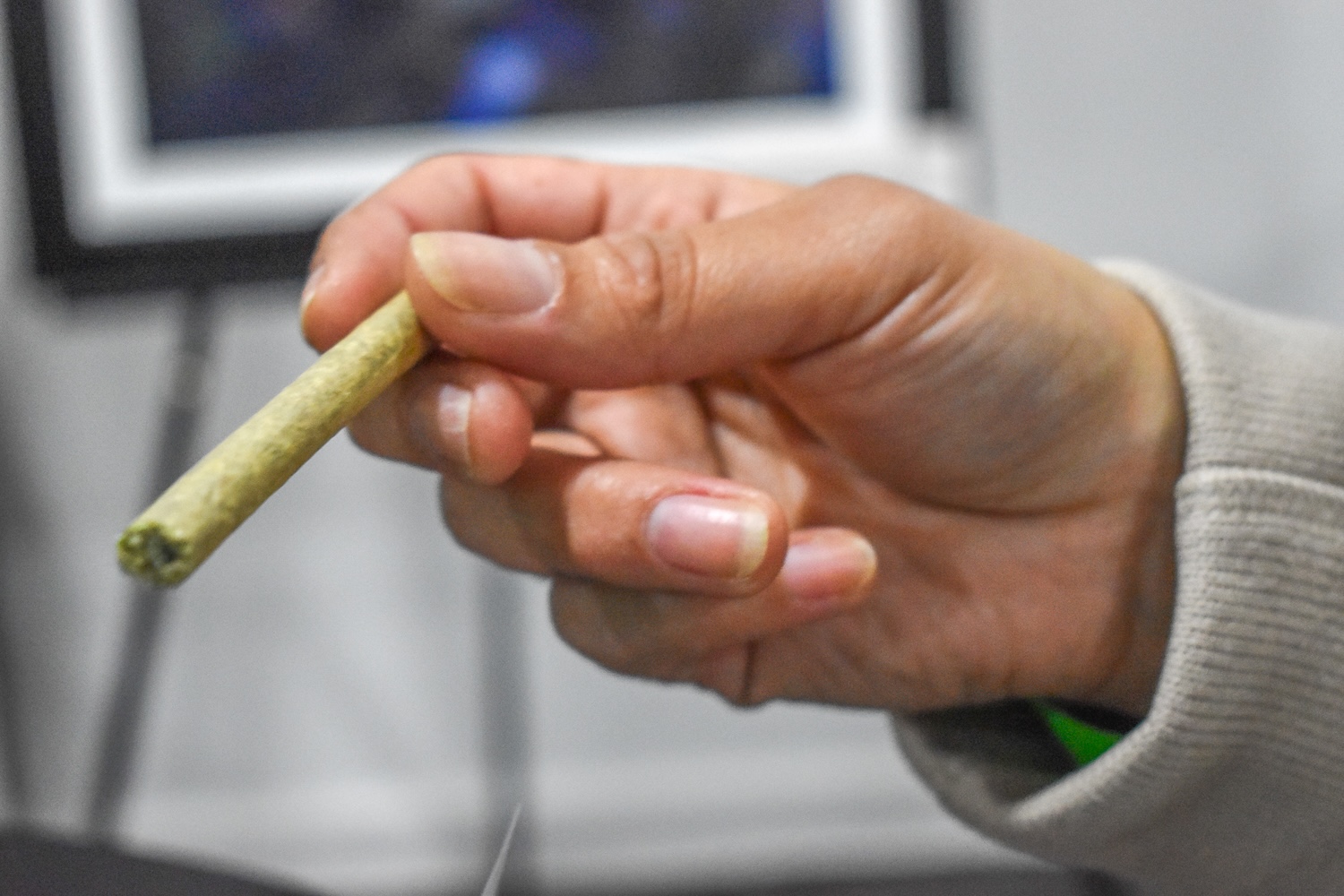
A cannabis pre-roll is held at a legalization anniversary party in Cranston, Rhode Island, Dec. 1, 2023. (Photo by Christopher Shea/Rhode Island Current)
by Jacob Fischler, Iowa Capital Dispatch
December 18, 2025
President Donald Trump signed an executive order Thursday to loosen federal restrictions on marijuana, which Trump said reflected the drug’s potential medical benefits while discouraging recreational use.
The order moves cannabis from Schedule I to Schedule III on the Federal Drug Administration’s list of controlled substances. Schedule I, the most restrictive category under federal law, indicates a high likelihood of abuse and no accepted medical value.
Trump said the move reflected that cannabis could have medicinal value, even if abuse was still possible.
The order “doesn’t legalize marijuana in any way, shape or form and in no way sanctions its use as a recreational drug,” Trump said. “Just as the prescription painkillers may have legitimate uses, but can also do irreversible damage … it’s never safe to use powerful controlled substances in recreational matters.”
Still, the order marks a major step in the decades-long liberalization of cannabis policy.
Since 2012, when Washington and Colorado voters legalized personal marijuana use, 22 other states have legalized at least some form of recreational use. Only 10 states still restrict both medicinal and recreational use.
In a statement, Colorado Gov. Jared Polis, a Democrat, praised Trump while calling for further reforms to bring federal law into harmony with states where the drug is legal.
“I thank the President and am pleased that they are finally taking this step to begin the process to reschedule,” Polis wrote. “Colorado’s cannabis industry is the gold standard ensuring that products are safe and regulated. It’s good to see the federal government finally following suit, but it’s frustrating it’s taken this long and there is much more to do for a full descheduling,”
President Joe Biden started the process for rescheduling the drug last year.
Medical angle
A group of administration officials and medical doctors flanked Trump during the Oval Office signing, with some speaking to the potential medical benefits of marijuana, including as an alternative to highly addictive opioid painkillers.
“The facts compel the federal government to recognize that marijuana can be legitimate in terms of medical applications when carefully administered,” Trump said.
Researching the potential benefits of marijuana is nearly impossible because of the tight restrictions on Schedule I substances, advocates have argued.
Removing cannabis from Schedule I would help ease those restrictions, Trump said.
“This reclassification order will make it far easier to conduct marijuana-related medical research, allowing us to study benefits, potential dangers and future treatments,” he said. “It’s going to have a tremendously positive impact.”
In addition to researchers, the split between federal law and the legal landscape in many states has created challenges for the industry, users and law enforcement, among others.
For example, the unusual position of state-legal businesses in a federally banned industry means they cannot use certain tax provisions, access some banking instruments or transport their product across state lines.
In a lengthy statement, Paul Armentano, the deputy director of leading marijuana legalization organization National Organization for the Reform of Marijuana Laws, offered qualified praise for the move, saying it “validates the experience” of patients who have used marijuana to treat chronic pain and other conditions.
“This directive certainly marks a long overdue change in direction,” Armentano said. “But while such a move potentially provides some benefits to patients, and veterans especially, it still falls well short of the changes necessary to bring federal marijuana policy into the 21st century. Specifically, rescheduling fails to harmonize federal marijuana policy with the cannabis laws of most states.”
The reclassification could provide tax relief to many marijuana businesses, he added.
GOP senators opposed move
Many Republicans in Congress remain opposed to legalizing marijuana.
In a letter dated Wednesday, 24 Senate Republicans urged Trump not to reclassify marijuana, which they said had a high likelihood of abuse and no medical value.
Allowing marijuana businesses to take advantage of federal tax deductions would give them a tax break of as much as $2.3 billion, allowing them to increase marketing efforts and expand into additional states, the lawmakers wrote. The benefits of economic growth would be outweighed by the costs of accidents, “not to mention the moral costs of marijuana advertising that could reach kids,” they wrote.
“In light of the documented dangers of marijuana, facilitating the growth of the marijuana industry is at odds with growing our economy and encouraging healthy lifestyles for Americans,” the GOP senators wrote. “We urge you to continue your strong leadership of our country and our economy, and to turn away from marijuana rescheduling.”
North Carolina’s Ted Budd led the letter, which was also signed by John Barrasso and Cynthia Lummis of Wyoming, Tom Cotton of Arkansas, Shelley Moore Capito of West Virginia, James Lankford of Oklahoma, Roger Marshall of Kansas, Pete Ricketts of Nebraska, Tommy Tuberville of Alabama, John Cornyn of Texas, Marsha Blackburn and Bill Hagerty of Tennessee, Jim Banks of Indiana, Ron Johnson of Wisconsin, Mike Crapo and Jim Risch of Idaho, Rick Scott of Florida, Kevin Cramer of North Dakota, Cindy Hyde-Smith of Mississippi, Lindsey Graham of South Carolina, Dave McCormick of Pennsylvania and Mitch McConnell of Kentucky.
Iowa attorney general joins objection to rescheduling cannabis From Iowa Capital Dispatch
Iowa Attorney General Brenna Bird joined the attorneys general of seven other states in a statement opposed to rescheduling marijuana.
A news release sent out by Indiana Attorney General Todd Rokita included the following joint statement:
“Since before President Trump took office, many of us—the Attorneys General of Indiana, Nebraska, Iowa, Idaho, Kansas, Louisiana, Oklahoma, and Wyoming—have argued against the rescheduling of marijuana as a Schedule I drug. See July 2024 Comment of Nebraska and 10 Other States.
“We all believe the science surrounding marijuana—which has become only more clear in recent weeks—properly establishes it as a Schedule I drug, and we have seen firsthand the harm the drug has caused in our communities. The negative impacts of expanded marijuana use, especially on children and adolescents, are worrisome. And the public policy challenges, such as the exponential increase in difficult-to-combat driving under the influence, are both significant and serious. We have conveyed our concerns to the Administration, and we are grateful for the Administration’s good faith consideration of our views.
“Because of our long-held views, we are concerned with the issuance of this Executive Order, which directs the Attorney General to ‘take all necessary steps to complete the rulemaking process related to rescheduling marijuana to Schedule III.’ We will evaluate the order closely to determine how we can best continue to engage, protect the public health, and ensure the safety of our citizens.”
Iowa Capital Dispatch is part of States Newsroom, a nonprofit news network supported by grants and a coalition of donors as a 501c(3) public charity. Iowa Capital Dispatch maintains editorial independence. Contact Editor Kathie Obradovich for questions: info@iowacapitaldispatch.com.