THE GAMES BEGIN: MAY 1904
by Mike Comfort
With the season scheduled to start May 6, the teams spent the month of April getting ready for the season.
The stockholders of Oskaloosa, known as the Quakers due to the religious denomination in town, raised $2,000 for the team’s organization and made plans to build a new park which would be “in southeast Oskaloosa on the line of the street railway. The location is in O’Neill’s addition and lies between the streetcar tracks and the Iowa Central Railway.” They also scheduled an exhibition between the Minneapolis Millers of the American Association for later in the month.
The American Association was at the highest level in the minors called Class A. It was pretty common for minor league teams from different leagues to play each other in exhibitions to prepare for the season and make some money. Boone and Waterloo would play Davenport and Cedar Rapids, respectively, of the Three I League, with the Iowa League teams losing each game. Keokuk played Crookston of the Northern League, also a Class D league, but lost as well. Crookston would have four players that eventually played in the majors. Fort Dodge would lose to the Omaha Rangers of the Class A Western League 5-4. The Rangers roster included Jack Pfiester who would win the World Series with the Cubs in 1907 and 1908.
Oskaloosa fared better than their Iowa League counterparts and beat Minneapolis 7-1.
While Minneapolis would finish 4th in the American Association in 1904, they had 7 players that would eventually play in the majors. Pitcher Cy Morgan would win two World Series with the Philadelphia Athletics in 1910 and 1911, going 33-19 during those seasons. Bill Maloney would lead the National League in stolen bases in 1905, with 59 for the Chicago Cubs. The Quakers couldn’t repeat their success when they played Cedar Rapids, losing 7-1 in front of 2000 fans.
As the season drew near, each team started to earn team nicknames, some which would stick and some which would not. Ottumwa was referred to as the ‘Kolts’ before acquiring the nickname Standpatters. Fort Dodge was dubbed the White Sox and the Cavedwellers. Other teams were the Microbes (Waterloo), Coalminers (Boone), River Rats or Redskins (Keokuk), and Grays (Marshalltown). It was also not unusual for players to move teams and leagues as the season approached.
In a humorous story, Davenport reacquired a 2B named Carlin who returned from Oskaloosa. Carlin said his treatment at Oskaloosa was “heartrending”, he “refused to live on Grape Nuts and sleep in a trundle bed”, and “did not fancy a town built around a square”. Athletes could be prima donnas in the early 20th century as well.
Prior to the season opener, President Norton met with the umpires (Golden, Flynn, Quigg, and Swigert) and issued his instructions to the league. He reiterated that he would support the umpires in all situations and that fines would not be remitted. He expected transportation to be given to games for the umpires and called for ‘ample’ police protection at games. He also declared that the new major league balk rule would be enforced.
The top four teams were expected to be Marshalltown, Waterloo, Burlington and Ottumwa, but the league got off to a rough start as two games were postponed to start the year (Waterloo vs Burlington and Marshalltown vs Keokuk). The Marshalltown Times considered this a ‘bad omen’ and mentioned that starting the season on a Friday is ‘bad luck’. The two games that were able to be played had controversy in each of them.
Ottumwa edged out Boone 6-5, but Boone’s manager Reynolds said that he would protest the loss after his disagreement with Umpire Flynn’s enforcement of the new balk rule. This was just the beginning of what would be persistent umpire struggles in the league. Reynolds’ odd behavior would continue as he protested another game a week later and then threw a bat at a Boone pitcher after he was hit.
In the other game that was played on opening day, 437 people showed up to see Oskaloosa battle Fort Dodge (now known as the Cliffdwellers or Dodgers). The Oskaloosa Herald described the game “as pretty of an exhibition of the national sport as one would care to see, barring perhaps the multiplicity of homeruns.” Complaints abounded of the fence being too close as the crowd did not enjoy the number of homeruns. One hundred and twenty years later, it is easy to chuckle at how times have changed. Quakers pitcher Fred Bridges struck out “no less than 15” and only gave up 5 hits, however, all of them were home runs which propelled Fort Dodge to win 9-5 (Oskaloosa also had 2 homeruns). In contrast to the Ottumwa-Boone game, the umpire “knows his business.”
More troubles occurred in regards to the scheduled Sunday games. At the time Oskaloosa prohibited Sunday games, and injunctions were threatened to be filed if an attempt would be made to play the games. A suggestion was made to move the game to Beacon, a town a couple miles from Oskaloosa, but arrests were threatened if the game was played. It was eventually determined to play those games somewhere else.

Games open in the rain (Marshalltown Times 5/7/1904).
Several oddities highlighted the month. In a game between Marshalltown and Oskaloosa, Marshalltown’s 3B Williams was ejected for calling the umpire a ‘big lobster.’ Marshalltown would later lose a game to Ottumwa, but protested the loss as a runner was called out after running to 1st, turning right, then running to 2nd.
The most ludicrous occurrence was a game between Waterloo and Oskaloosa that ended 10-0. It was later found that the pitching mound was 2 feet too far from home plate and second base to home was 12 feet too far. The game was protested as well. A 3rd protested game happened between Waterloo and Boone. A Boone player by the name of Johns was accused to be a player named Phil Deller who actually belonged to Davenport of the Three I League. Waterloo protested all the games he played in. It was later determined that he was property of Davenport and President Norton banned Deller (or Johns) from playing in the Iowa League.

Incident where Marshalltown’s Williams calls Umpire Swigert a ‘big lobster’ (Marshalltown Times 5/16/1904)
Highs and lows occurred throughout the month. In one game Ottumwa beat Keokuk 26-3 (supposedly Ottumwa had 9 hits and Keokuk 24, but that has to be a misprint). A week later, Keokuk beat Burlington 1-0 with a homerun in the 12th, proving that baseball brings a daily rebirth.
Attendance was typically in the hundreds for games, but one game between Oskaloosa and Ottumwa brought in 3000 fans, while another game between Ottumwa and Waterloo brought in 2500. On the other end, a game between Oskaloosa and Waterloo only drew 67 due to rain.
Most games took roughly an hour and a half to play. It was rare to have a game go over 2 hours, but Ottumwa and Marshalltown played a 2:10 contest, which was one of the longest of the year. Boone and Oskaloosa would play one of the shortest games (both part of a double header) at 1:05 and 1:10 a piece. Each game had the same battery.
A few pitching performances highlighted the month. Louis Schaub of Waterloo struck out 16 in a game against Oskaloosa. Oskaloosa’s Fred Bridges returned the favor a few days later when he threw a 1 hitter, with no runners getting past 1st base. Bridges’ 9 strikeouts and 1 walk propelled the Quakers to a 10-0 win. Bridges was quickly proving to be one of the best pitchers in the league.
Two no-hitters were thrown. Schaub, now pitching for Ottumwa, no-hit Burlington on May 26, with Ottumwa winning 4-0. The very next day J.H. Mekenson no-hit Ottumwa, as Burlington turned the pages and beat Ottumwa by the same 4-0 score.
Perhaps the most impressive performance of the month was Willie Wilson of Marshalltown playing 3 games in 2 days on a broken right leg.
A 13-3 stretch in the middle of May propelled Ottumwa to first place at the end of the first month with a 16-5 record. Fort Dodge followed a 2-7 stretch with a 5 game win streak to stand in 2nd with a 14-9 record. Marshalltown was schizophrenic as they sandwiched 4 game win streaks around a 5 game losing streak, and sat in 3rd place at 12-9.
Keokuk almost replicated the feat with a 5 game win streak, 4 game losing streak, and then a 5 game win streak. Keokuk was playing with a heavy heart as their manager Harry Miller, passed away just two months before the beginning of the season. They were 4th at 10-9.
Boone finished the month on a 2-7 slide and held an 11-11 record, while Burlington sat at 9-13. Waterloo shook off their 2-10 start to finish May at 8-15, while Oskaloosa brought up the rear with a 7-16 record, mostly due to a 3-10 stretch.
A competitive month built excitement for the Iowa League, but unfortunately, controversies would occur in June.
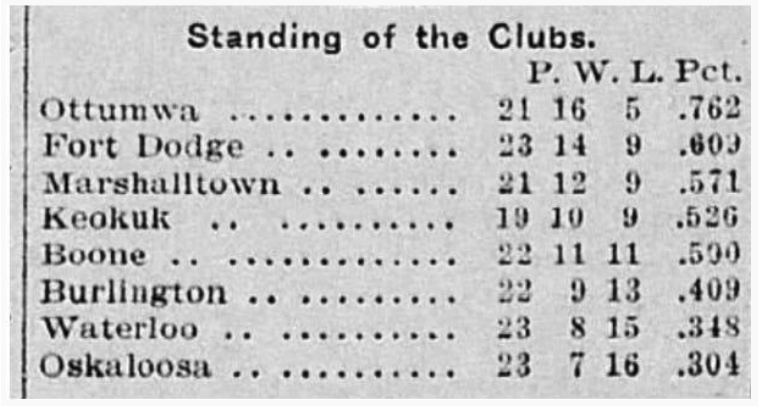
June 2, 1904 Standings (Marshalltown Times)
Sources:
Oskaloosa Herald, Ottumwa Courier, Davenport Times, Cedar Rapids Gazette, Marshalltown Times, Davenport Star, Davenport Times, Waterloo Courier, Sioux City Journal, Society for American Baseball Research, Iowa State League Game Logs (Compiled by Mike Comfort)
This article is copyright Mike Comfort and used with his permission. You can read more at his Substack by clicking HERE.
Mike Comfort is an Oskaloosa native as well as a baseball and history buff. He resides in Oskaloosa and is an educator and coach.