THE CREATION OF THE IOWA STATE LEAGUE
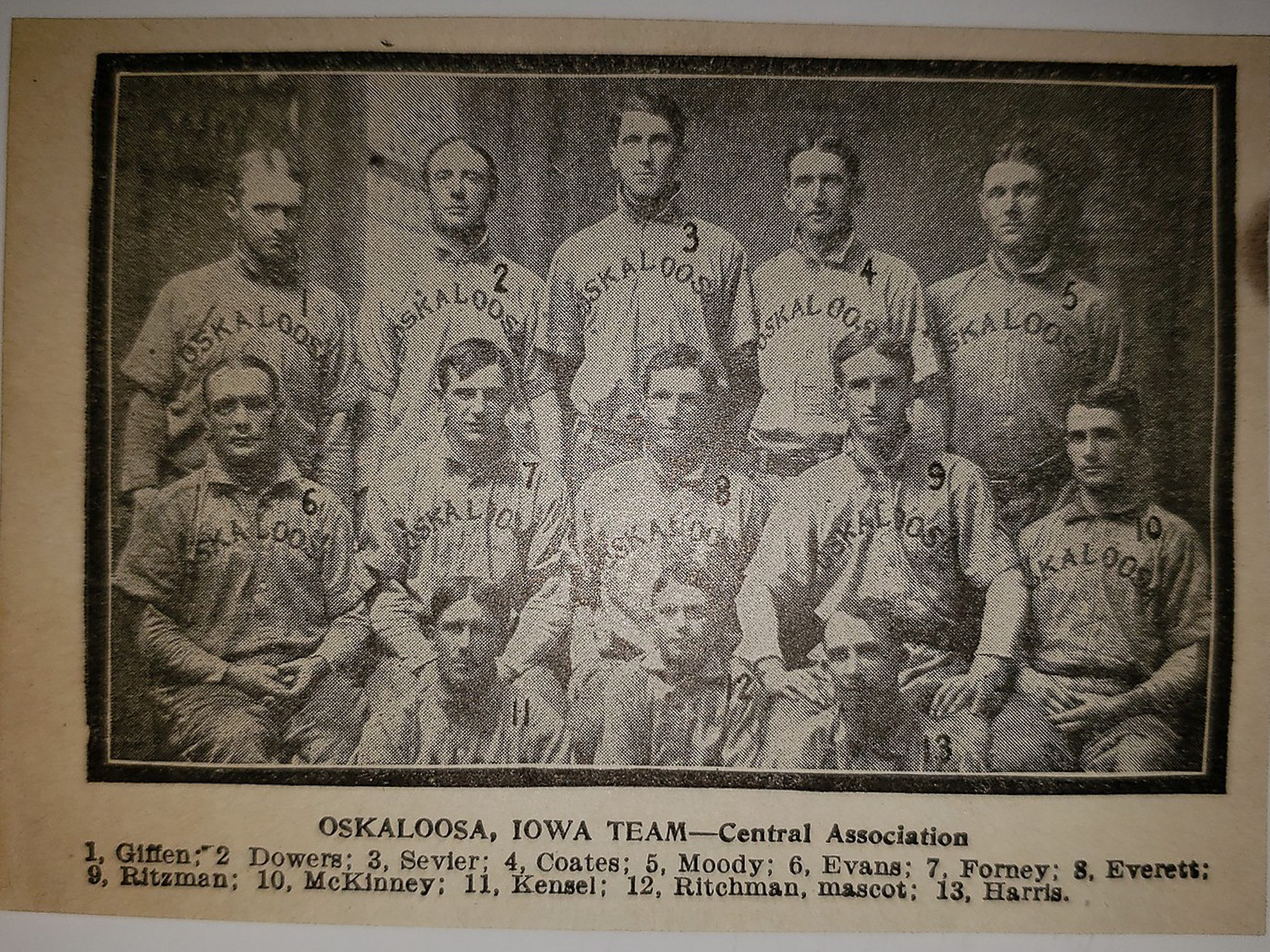
Oskaloosa Quakers baseball team picture. (archive image)
by Mike Comfort
Prior to major league baseball teams developing the farm system, minor league franchises were independent teams that operated in almost every town in the United States. By 1910, there were 50 different minor leagues which included large cities like Minneapolis, Baltimore, Los Angeles, and Denver. However, minor leagues weren’t just limited to large cities, small towns had their own teams and leagues as well. One of those small town minor leagues was created 122 years ago and named the Iowa League of Professional Baseball Clubs, commonly known as the Iowa State League. It consisted of teams from Boone, Burlington, Fort Dodge, Keokuk, Marshalltown, Oskaloosa, Ottumwa, and Waterloo. These towns would raise capital for a team, acquire players, hope for a pennant winner, and live and die by their teams. Players could find decent paying jobs just by playing for these teams from season to season, even if they never made the majors. All the while different minor leagues worked with each
other to sell players in order to acquire cash to pay bills or find the player that could help them win the league championship. It’s a system that does not resemble anything that currently exists in baseball, but it’s a fascinating story in the history of the sport. This is the story of the Iowa State League.
Speculation of a new all Iowa League commenced once the 1903 baseball season ended. As the league progressed towards its beginning, there were numerous conflicting reports of what towns were interested and who would be included, sometimes within days of each other. One account of the creation of the league was given by Mike Flynn in 1905 after the league played its first season. Flynn, who would umpire in the Iowa State League, credited F.C Norton of Burlington and Jim Meyers of Waterloo with organizing the league. Meyers, who was part of an independent team in Waterloo, conceived the idea and sent feelers out to various managers in the state to see if any interest existed. He found an ally in Norton and soon a meeting was advertised, “a baseball meeting for the purpose of forming a state league will be held at the Ballingal Hotel in Ottumwa, Iowa, December 28, 1903 AD.” The meeting occurred despite poor weather which made travel a challenge, plus renovations in the hotel which hampered the environment. Flynn noted that representatives would trip over tools and other construction materials as they moved about the hotel. On top of this, the hotel owner almost kicked the representatives out as he thought they were labor organizers trying to organize the construction workers. Fortunately, someone was able to vouch for them and the meeting was allowed to occur. When the meeting finally started, four towns were represented in person with another two by ‘proxy’, although Boone would come eventually. His representative said he thought A.D. stood for after dark. It’s fair to question the authenticity of this anecdote, but Flynn claimed it was true. Norton was elected president on day one and the meeting adjourned. This was the end of Flynn’s account, but other sources fill in the gaps.
One of the earliest mentions of a potential Iowa League came on September 2, 1903 in the Davenport Republican which mentioned the inclusion of Davenport in the ‘proposed Iowa Baseball League’ would be ‘folly.’ In November, the Sioux City Journal mentioned that the league had been talked about since the close of the 1903 season and would include Fort Dodge, Boone, Waterloo, Marshalltown, Burlington, Oskaloosa, Ottumwa, and Muscatine. Just one month later, the same paper would include Webster City, Algona, Creston, Oelwein, and Council Bluffs, as potential teams. The Davenport Republican was the first to mention Keokuk as a potential team as well as a salary limit of $700-800 for the league. The Sioux City Journal added that Waterloo couldn’t break into the Three I League, which was the impetus for the league forming and seemingly validating Flynn’s story of Jim Meyers recruiting teams. The Three I League, officially the Illinois-Indiana-Iowa League, was a minor league that existed from 1901-1961. It was one of the premier minor league leagues and played at the Class B level with most of the towns having a population of 25,000-40,000. The Iowa League would be Class D, with most of their towns having a population of 8,000-18,000.
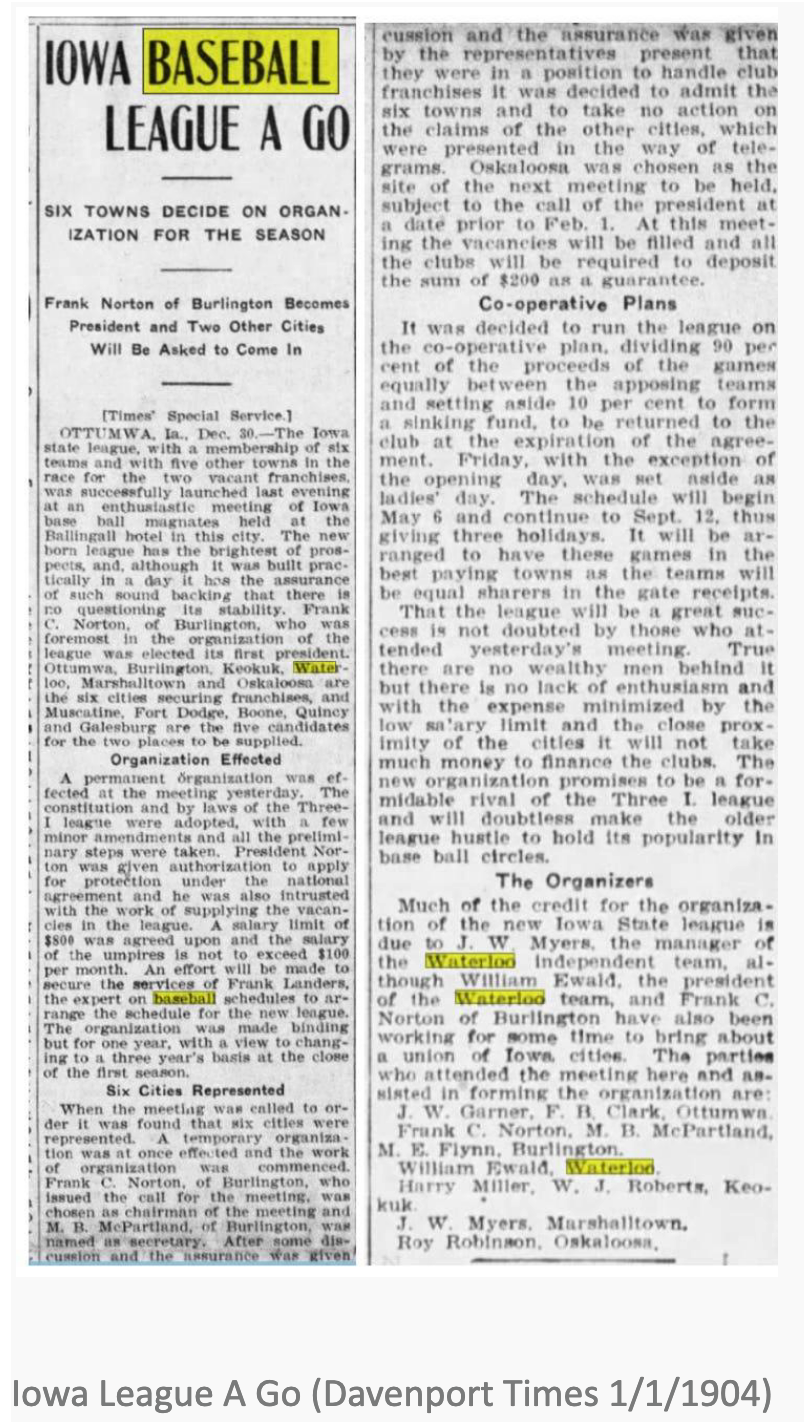
The Davenport Times gave more details of the meeting in Flynn’s account. Seeming to further confirm Flynn’s recollection, it gives credit of the organization of the new league to F.C. Norton of Burlington, JW Meyers of the Waterloo Independent Club, as well as William Ewald, the Waterloo president. It mentions that the league was a go with Ottumwa, Burlington, Keokuk, Waterloo, Marshalltown, and Oskaloosa. Other potential teams to join were Muscatine, Fort Dodge, Boone, Quincy (IL), and Galesburg (IL). This is the first report to name all the teams in the same article that would eventually be in the league. The Iowa State League adopted the constitution and bylaws of the Three I League and imposed an $800 salary limit with umpires being paid $100 a month. 90% of the proceeds of the games were divided equally with the other 10% in a sinking fund, which would be returned to the club at the expiration of the agreement. Friday was set aside as ladies days, a common practice where women obtained free admission to the game. The season would run from May 6 through September 12th with the hope of being a rival to the Three I League.
(submitted image)
Despite the seeming concrete nature of the Times report, the league wasn’t actually confirmed with the eventual teams until February. In the meantime other towns that did not make the league were rumored including Iowa City, Centerville, and Clinton. At an organizational meeting in Oskaloosa in February, six teams’ money was accepted by the league: Burlington, Keokuk, Ottumwa, Marshalltown, Waterloo, and Fort Dodge with the last two teams coming down to Boone, Oskaloosa, Muscatine, and Centerville (Galesburg eventually joined the Western Illinois League). Ottumwa established a corporation to last 20 years by selling 600 shares of $5 to fund the team. By February 22, Boone joined as the 8th team, picked over Muscatine as the other option, with Oskaloosa joining within the previous week. Two umpires had also been hired. All the teams except Boone and Marshalltown had their players signed by March 12. Marshalltown would be helped by native son and baseball Hall of Fame player Cap Anson with their signings.
With the league now formed, expectations were extremely optimistic. The Marshalltown Evening Times trumpeted the new league, declaring that it was a “revival for the national game in Iowa”, it will foster “spirit” in neighboring towns, and it was the “most notable advancement in baseball the state has seen.” On top of that, the expected success of the league would prompt other smaller leagues to spring up and draw teams for the Three I league. The paper was surely playing up the new league to its readers, but there is no doubt that optimism was high for the new league as it looked towards its first season in 1904.
Resources
Davenport Republican, Sioux City Journal, Davenport Times, Marshalltown Times, Oskaloosa Herald, Ottumwa Courier, Baseball Reference, www.census.gov
This article is copyright Mike Comfort and used with his permission. You can read more at his Substack by clicking HERE.
Mike Comfort is an Oskaloosa native as well as a baseball and history buff. He resides in Oskaloosa and is an educator and coach.