Senators advance bill to prevent state government shutdowns
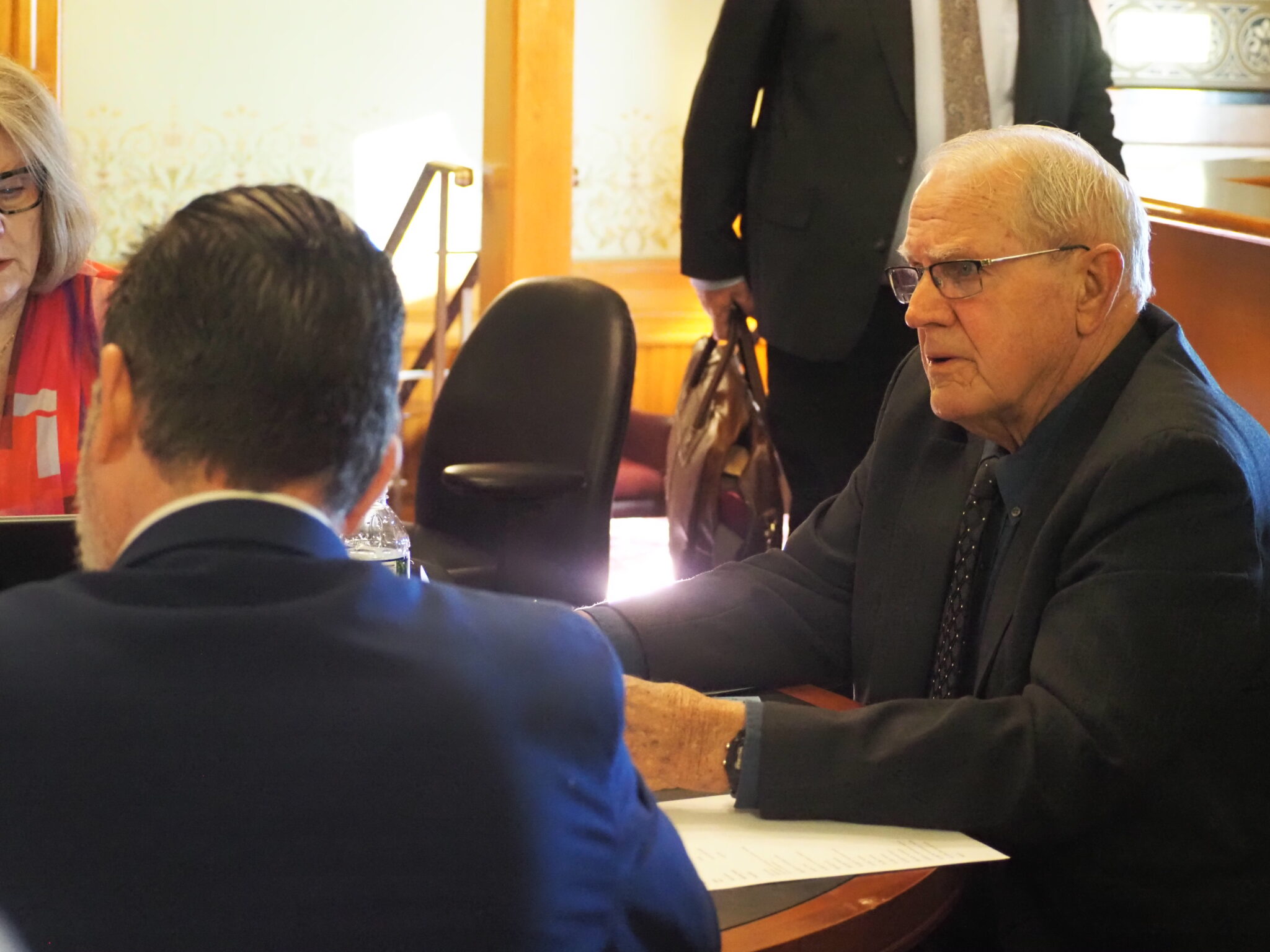
Iowa Sen. Ken Rozenboom, R-Oskaloosa, led a subcommittee meeting Feb. 18, 2026 on continuing state appropriations in years where the Iowa Legislature does not approve a budget by the new fiscal year. (Photo by Robin Opsahl/Iowa Capital Dispatch)
by Robin Opsahl, Iowa Capital Dispatch
February 18, 2026
Iowa could avoid state government shutdowns if the Legislature does not pass a budget before the next fiscal year starts under a measure advanced by a Senate subcommittee and committee Wednesday.
Senate Study Bill 3176 would establish a continuing appropriation for fiscal years when the Iowa General Assembly does not pass and present an annual budget to the governor on or before July 1 — when the fiscal year begins for the state.
If budget bills are not passed by this date, appropriations from the previous fiscal year would continue, with the Iowa Department of Management, in consultation with the Legislative Services Agency, determining appropriate funding levels for continuing line-item appropriations, standing limited and unlimited appropriations, as well as funding from federal and non-state funds from the immediately preceding fiscal year.
Lawmakers often have to extend the legislative session and occasionally have convened in special session to finish budget action but they have not shut down the government due to failure to pass spending bills.
The Senate State Government Committee amended the bill to allow the Department of Management and Department of Administrative Services to reduce spending if necessary to comply with the Revenue Estimating Conference’s spending limitation if lawmakers have adjourned without passing a budget.
Rep. Cindy Winckler, D-Davenport, questioned what would happen for issues like setting the state’s per-pupil funding rate through State Supplemental Aid — a process which typically takes place and is approved earlier in the legislative session.
Winckler asked how additional school funding approved for a school year would be addressed if the Legislature would be “going on previous year appropriation.”
In addition to questioning specific portions of the bill, Winckler said she was opposed to the overall goal of the measure. Changing the law to allow for continued appropriations when lawmakers fail to pass a budget would mean the state Legislature was abdicating its duties, she said.
“When I think about the role of the House and the Senate, one of the largest roles is to pass a budget,” Winckler said. “So, would we be walking away from our responsibilities?”
Sen. Scott Webster, R-Bettendorf, said he believed in a case where the Legislature has not passed a budget by the beginning of the fiscal year, lawmakers already have the ability to “walk away from that responsibility by not passing a budget (and) having a government shutdown.”
“And I think government shutdowns are wrong,” Webster said. “… I don’t like government shutdowns at the federal level. I don’t like them at the state level. That’s why I like this bill.”
There have been a series of federal government shutdowns in recent months as Democrats have leveraged appropriations bills to pressure the majority party and President Donald Trump’s administration to take action on issues like extending the Affordable Care Act tax credits or putting more restrictions on federal immigration enforcement.
Jake Highfill with the groups Iowans for Tax Relief said Iowa has come close to shutdowns in 2010 and 2013, and said he believed the measure would provide taxpayers with long-term stability.
“Lots of bills that we are filing this year, we believe have long-term effects — raising income tax for two-thirds majority, stuff like this, protects the taxpayer in the long term,” Highfill said, referencing a proposed constitutional amendment that would require a two-thirds majority vote from the Iowa Legislature to increase individual or corporate income tax rates.
Highfill also said his organization has supported the continuing appropriations policy for five or six years. Though the 2026 gubernatorial election was not directly mentioned in the meeting, the legislation comes as Iowa voters face the first open race for governor in several years, with Gov. Kim Reynolds not running for reelection.
There are several other measures being considered by Iowa lawmakers putting limits on the governor’s power, such as a bill banning the governor from ordering emergency closures of places of worship. The bill was scheduled for consideration in the House Judiciary Committee on Thursday. Another, Senate File 2314, which passed the Senate State Government Committee on Thursday, would require lawmakers to approve major administrative rule changes by state agencies and also reduce gubernatorial appointees’ terms to four years.
Another bill, Senate File 2209, would cut the annual legislative session in half, from 110 or 100 days to 55 or 50 days, leaving less time for budget deliberations. The bill passed the State Government Committee but chair Sen. Ken Rozenboom, R-Oskaloosa, said he intends to offer an amendment to propose an interim study committee on the issue instead of making the change this year.
House Speaker Pat Grassley and other Republicans have said these measures are not motivated by a concern that a Democrat — such as Iowa Auditor Rob Sand, the frontrunner to become the Democratic gubernatorial candidate in 2026 — could win in the upcoming election.
Winckler said the continuing budget measure could provide lawmakers an avenue to avoid finding compromises. Currently, Iowa is controlled by a Republican trifecta.
“I think it would give an opportunity for the Legislature just to walk away, instead of working together and making a decision and passing a budget and reflecting the needs of Iowans across the state,” Winckler said. “Something like this can be done in an emergency situation, but having something like this on the books for any time that we decide to — that the Legislature might walk away from our responsibilities — I think is not wise.”
Rozenboom said he expects further changes to the bill.
“This is the first step there,” Rozenboom said. “… Other committees will work with this, we will have the amendment process, so we will have a thorough and complete discussion of this matter as the days move forward.”
Iowa Capital Dispatch is part of States Newsroom, a nonprofit news network supported by grants and a coalition of donors as a 501c(3) public charity. Iowa Capital Dispatch maintains editorial independence. Contact Editor Kathie Obradovich for questions: info@iowacapitaldispatch.com.