Pella City Council Votes To Deny Mahaska County 28E Departure
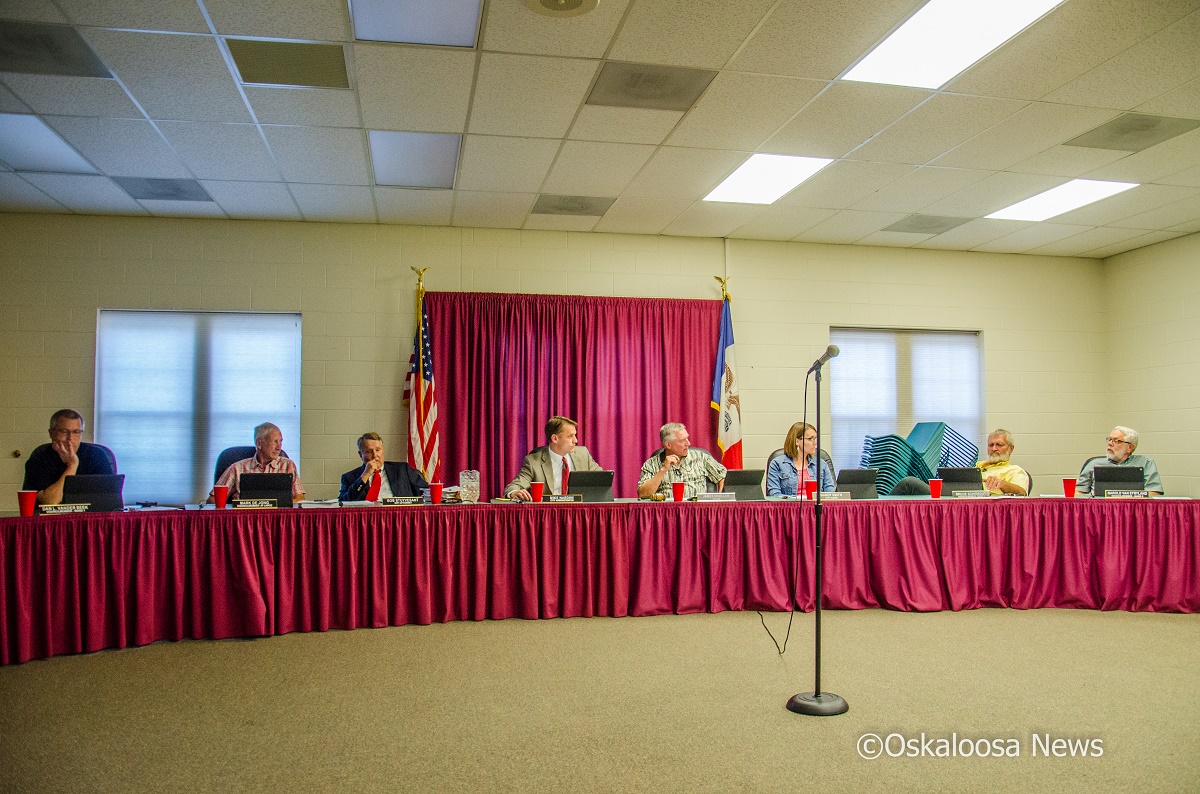
Pella City Council
Pella, Iowa – At the final meeting in June, the Mahaska County Board of Supervisors voted 2-1 to leave the 28E agreement it had signed with the cities of Pella and Oskaloosa to build a regional airport.
The vote to leave was spearheaded by Mahaska County Supervisor Mark Doland, whose political base is built upon bringing an end to the agreement that was signed before he was elected to office in a special election.
After the meeting with the county’s retained attorney, during which options were given regarding the 28E agreement, Doland said that, according to the retained attorney, “permission doesn’t need to be acquired” in order for the county to exit the agreement.
“The overall makeup of the board is we don’t support the airport project,” said Doland before the board’s vote took place.
Supervisor Willie Van Weelden, who has been a supporter of the airport, asked Doland to produce the letter from the attorney advising the board to depart from the 28E agreement, “Because I didn’t hear that from him the day we met with him in closed session.”
The vote by the Pella City Council was the 3rd such vote concerning Mahaska County and the 28E agreement.
Pella City Administrator, Mike Nardini, referenced the resolution that would deny any resolution passed by Mahaska County to remove all reference to Mahaska County from the 28E agreement.
Nardini referenced the original 28E agreement that requires all parties of the agreement to agree on amendments to the resolution or termination of the agreement. “The city’s legal counsel and staff does not believe the county has the ability to unilaterally change the 28E agreement.”
Nardini said that the city of Pella began its work on a new airport plan due to concerns from the Federal Aviation Administration over the current Pella airport, which is a Category 2 airport.
Nardini spoke about the expected 30 million dollar cost for the new airport, “a significant financial commitment,” which includes the 6.8 million dollar cost that will be divided by the two cities, with no financial liability for the county.
Operational costs will be split 60% by Pella and 40% by Oskaloosa, with no financial cost incurred by the county.
Nardini said that those significant costs are why provisions are placed in agreements that require unanimous approval by all in order to change an agreement like the one between Pella, Oskaloosa, and Mahaska County.
Nardini said that the 28E agreement is for the life of the regional airport. “This is a long term commitment.”
“In the event one of the parties exercises their legislative authority to deny or significantly delay the project, that party is liable to the other parties for liquidated damages in the amount of $250,000.00 per occurrence,” said Nardini to the council. Nardini said that the provisions of the 28E agreement were in place to protect the financial investments being incurred to develop the project.
The Pella City Council voted unanimously to deny Mahaska County’s language to depart the 28E agreement.
The Mahaska County Board of Supervisors carved out $50,000 when developing the budget to pay for legal counsel during their January worksessions.
Both Pella and Oskaloosa held closed sessions following their most recent regular city council meetings.
If the two cities were to invoke the liquidated damages of $250,000.00 per incident, costs to the Mahaska County taxpayer could start to climb exponentially. If each vote by the Mahaska County Board of Supervisors was used as an occurrence, the total could be $750,000.00 that the Mahaska County taxpayer would be liable for. Legal fees could easily push that total amount over the 1 million dollar mark.
Mahaska County, under the current 28E agreement, lacks financial liability for the airport, and pays nothing for development costs.
The FAA recently issued “Finding of No Significant Impact” for the airport, and the project is now procuring engineering services for the design and construction of the regional airport.
This step also includes obtaining ground for the project, along with the possibility that eminent domain would be used to acquire ground. This issue has stood center stage in the political fight over the airport.