Bill removing state affirmative action measures approved by Iowa House panel
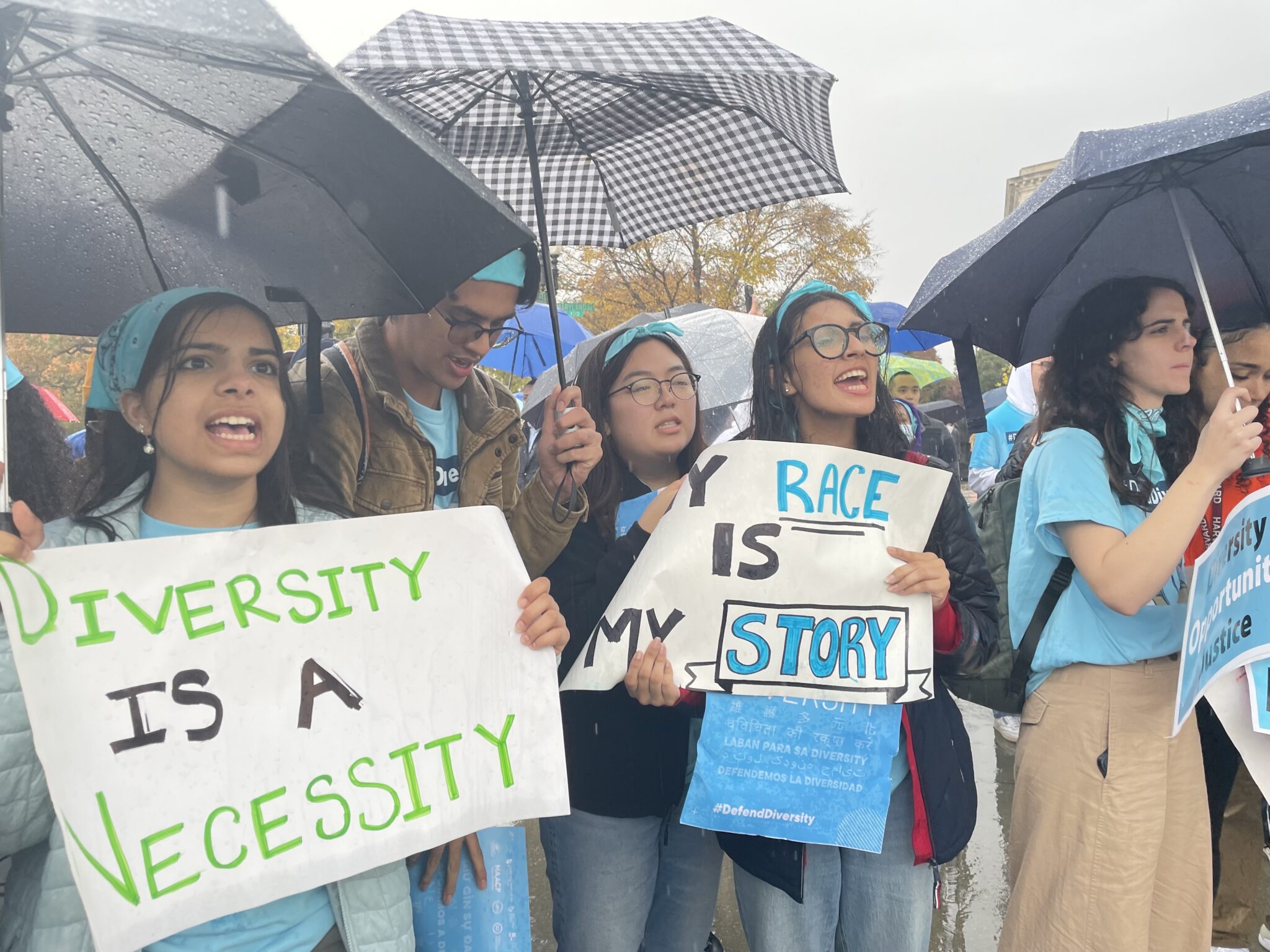
Harvard student Samaga Pokharel, right, with “My Race is My Story” sign, joined other students and supporters of affirmative action outside the U.S. Supreme Court Oct. 31, 2022, as it heard two cases that could reshape college admissions policies. (Photo by Ariana Figueroa/States Newsroom)
February 5, 2026
House Republican lawmakers were met with boos and arguments from members of the public at a Thursday subcommittee meeting as the panel advanced a proposal removing “affirmative action” requirements under Iowa law.
House Study Bill 668 proposes removing several affirmative action and equal opportunity measures currently required under Iowa state law. Opponents of the measure called the bill a continuation of efforts taken in previous legislative sessions to repeal civil rights protections in Iowa law.
The bill would eliminate required affirmative action plans and reports for a variety of state and educational entities, including the Iowa departments of Education and Administration, the state Board of Regents, community colleges, school districts, area education agencies and the judicial branch.
Adam Bessman, a Drake University student and program director of the Iowa Queer Student Alliance, told lawmakers the purpose of “affirmative action” measures and similar protections the bill proposes ending are measures that seek to ensure the constitutional value of “equality under the law” is properly executed.
Bessman said as someone who grew up in a predominantly Hispanic community, “I witnessed many of my peers being mistreated by educators and administrators, as well as passed over for opportunities of which they were more than deserving, not based on the content of their character, but on the color of their skin and of their heritage. I believe that if my community had affirmative action initiatives like that are currently employed at the state level, these negative experiences could have been avoided.”
Bessman added: “Ask yourselves: if all that affirmative action and the similar policies that this bill seeks to eliminate is doing is ensuring that the values of our constitution are being upheld for everybody — for women, for people of color, for everybody — why are you seeking to eliminate them?”
Rep. Samantha Fett, R-Carlisle, said with the policies lawmakers passed on restricting diversity, equity and inclusion efforts, known as DEI, during the 2025 session, “this bill is necessary to update code.” Her comments on the measure were met by “boos” from the crowd — as were comments from Rep. Skyler Wheeler, R-Hull, who chaired the subcommittee. Attendees chanted “shame, shame” at the GOP lawmakers as they left the subcommittee meeting.
Sen. Renee Hardman, D-West Des Moines, alongside several other speakers, criticized lawmakers for moving forward with the bill after it was introduced and available on the Legislature’s website less than 24 hours prior.
“We as elected officials have one major obligation, and that is to listen and learn and to lead,” Hardman said. “In order to listen, we have to give people access — access and time to do just that. … We are better, and our people deserve better. And I urge you to consider slowing this process down or shut it down, because we in Iowa have issues around people staying here, young people staying here. And it’s this very reason why Iowa cannot keep our young people.”
Rep. Megan Srinivas, D-Des Moines, thanked Iowans who were able to attend and speak at the meeting, saying even with the short notice of the meeting, there are “more people in this room than we can fit,” and of all who came, “not a single person thinks this is a good idea.”
Srinivas said the backlash against the proposal is because it “legalizes discrimination,” and would stand against the core values of Iowa promoted by both Democrats and Republicans like former Gov. Robert Ray to improve Iowa by supporting diverse populations in the state.
“I can’t say I’ve ever been this disappointed in something that has been brought toward me in four years,” Srinivas said. “This is not the Iowa I want to build.”
One portion of the bill that drew significant pushback were proposals to remove the requirements unanimously approved in 2020 requiring the Iowa Law Enforcement Academy to adopt rules on racial and cultural awareness training, and for law enforcement agencies to provide annual trainings related to deescalation techniques and preventing bias.
Speakers also criticized was a provision to eliminate requirements stating applicants for work licenses in fields like health care, architecture, engineering, land surveying and real estate cannot be deemed ineligible due to “citizenship.”
Vanessa Marcano-Kelly, board chair of Iowa Migrant Movement for Justice, said this provision would have potentially catastrophic impacts on Iowa’s health care system, which already faces workforce shortages. Marcano said her husband’s mother is in a nursing home and “if it weren’t for the immigrant staff, everyone in that nursing home would just be completely without any type of care.”
“I know that you’re going to vote yes on this bill. I urge you to vote no,” Marcano-Kelly said. “I urge you to go to Iowa nursing homes and see what’s going on there, and really see the significance of having a workforce that cares for our parents, for our elderly people.”
The academic incentives for minorities, the minority and women educators enhancement, and College-Bound programs encouraging higher education institutions to make plans and provide assistance for students and staff from underrepresented groups would be eliminated under the bill. It also would strike current requirements related to prioritization and consideration of how health care institutions and practitioners are addressing the needs of underserved racial and ethnic minority populations.
Wheeler said the bill “ensures opportunities are awarded based on hard work, talent, qualifications.” Both Wheeler and Fett signed off on the bill moving forward, while Srinivas opposed the bill.
House Speaker Pat Grassley told reporters at a Thursday news conference “there’s more work” to be done on the bill, and he said discussions will continue based on the feedback heard in subcommittee. However, he said House Republicans are committed to the goal of promoting a “merit-based system” in Iowa.
“We’re going to continue to continue to have a conversation on this bill,” Grassley said. “We’ve been very firm in our position that Iowa should be a merit-based state, and so that’s why the bill comes forward.”
Iowa Capital Dispatch is part of States Newsroom, a nonprofit news network supported by grants and a coalition of donors as a 501c(3) public charity. Iowa Capital Dispatch maintains editorial independence. Contact Editor Kathie Obradovich for questions: info@iowacapitaldispatch.com.