Students And Parents Learn About Online Safety
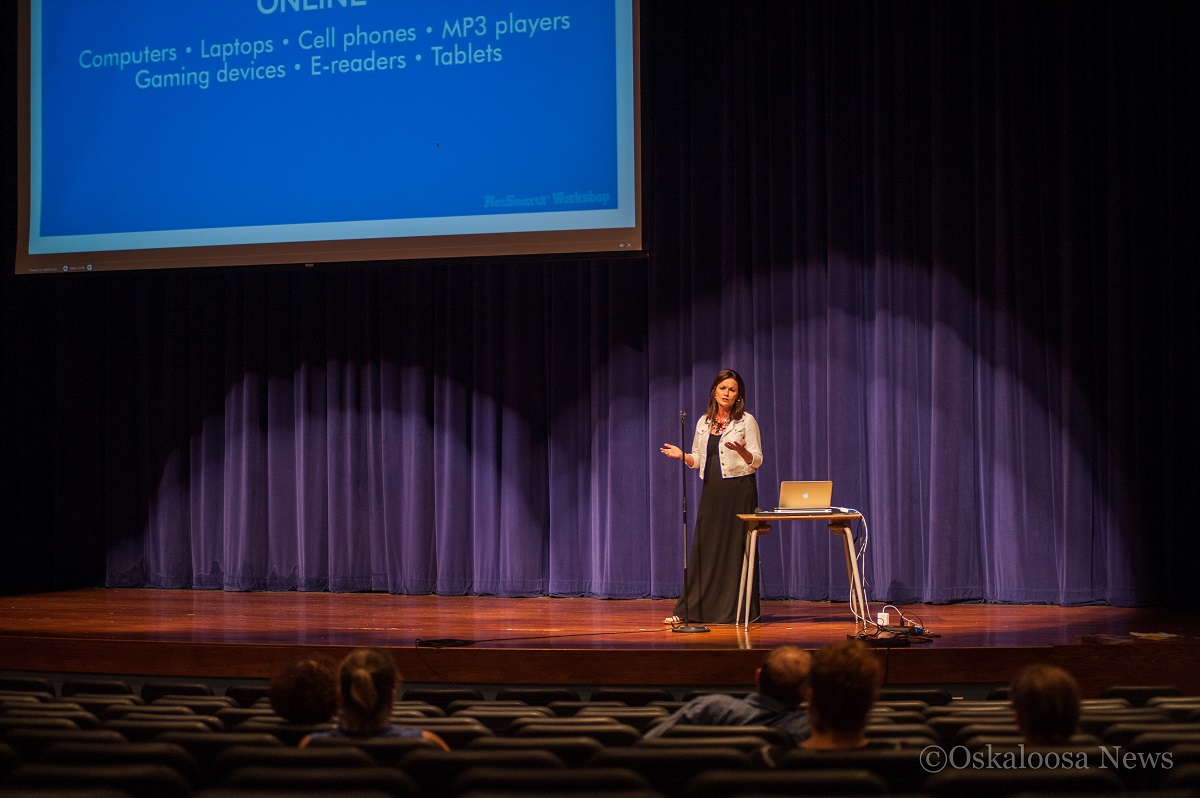
Karen Gale, Victim Specialist with the Federal Bureau of Investigation (FBI) was recently in Oskaloosa to talk with students and parents about online safety and cyberbullying.
Oskaloosa, Iowa – The online world provides many opportunities to learn, understand and explore our world from the safety of home or school. That same easy access to information can come with a dark side as well, allowing those that prey upon our youth easy access.
Karen Gale, Victim Specialist with the Federal Bureau of Investigation (FBI) recently stopped by Oskaloosa, where she gave presentations to Oskaloosa Middle School and High School students about how to keep safe from predators while online, and dealing with cyberbullying.
Gale also gave a presentation to parents later that evening, in a effort to further educate about online safety for children, and steps parents can do to help keep their kids safe.
During the presentation to students, Gale covered cell phone usage, sexting and cyberbullying. Gale also talked to the students about the sharing of information, and how much of that personal information, and how that can be a problem for students and their current and future privacy. “We talk a lot about their responsibility to insure their own safety, but the biggest thing I do is bring information and education,” says Gale.
According to Gale, online sexual exploitation is the largest problem the FBI deals with in Iowa. “Also the self production and distribution of child pornography, because if you’re under the age of 18 and you take a sexually explicit picture of yourself, or someone else, and you send it… you have both produced and distributed child porn. Now, in the State of Iowa, I know of no US Attorney who’s going to prosecute teenagers, but eventually the law will catch up with everyone.”
Gale explained to the students that once you create and send that content, you can’t get it back. “The only time you have control of whatever you’re going to send… is before you hit the send button. Once it’s out there, you never get it back.”
“They [kids] live under this fallacy that on Instagram, Snapchat, all of those quick Kik programs and things like that, that the picture only shows up for 10 seconds then it’s gone. Well the reality is… it’s still out there somewhere.”
In generations past, a bully’s influence mostly impacted a student during their time at school or in some social settings. But today, social media allows bullying to continue throughout the day and into the confines of a student’s safety zone at home.
“Cyber bullying is replacing face-to-face bullying and they never get away from it,” explained Gale. “It’s a constant 24-hour bombardment from the bullies to the bullied.”
Gale says that initial steps to help combat cyberbullies is to block the individual that’s bullying them. “If it continues to be harassment level, report it to law enforcement.”
Gale encourages students to always tell a trusted adult about the bullying. She explained that, many times, if an adult intercedes on behalf of the child, the bullying will tend to stop. “It’s also about not persecuting the bullied, but to make the bully take responsibility for their actions.”
“It’s all good to block it and change your number, but that bully needs to be held accountable by making the report or talking to law enforcement.”
When it comes to bullying, there can be distinctive differences between the genders. “Girls are usually much more mean,” Gale said, explaining that girls tend to be more passive-aggressive and won’t do it to the victims face “but will certainly do it over Facebook or text messaging.”
“Guys who bully each other eventually get tired of it, or if they are harassing a girl, it changes into a sexual harassment bullying,” said Gale.
Even after middle school and high school, those bullying tendencies can carry over into the work place. “There is bullying in the work place on a monumental scale,” says Gale. “If you were a bully in high school, you usually tend to be a bully as an adult, and then you also teach your children to bully by example.”
For parents that are concerned about how to protect their child, Gale explained that “parents need to be nosy and not your kids best friend. If they have a Facebook account, you need to be on their Facebook account. You need to have them bring it up and show you all their friends and see what their privacy setting is set to.”
“If they are up in their room on their computer for two or three or four hours a night, you need to get them out of their room. That computer shouldn’t be in their room,” said Gale. “I was one of those mean parents who had the password to our computer and the kids couldn’t get on until I was home.”
“You can build a trust level with a child as long as they are educated and informed as to where they can go or can’t go. Not to erase the history on their computer, so the parents can ask those questions and look and see where those kids have been. It’s just another extension of good parenting.”
Gale said that on cases she has worked, the parents “never have an idea this is taking place,” because children can be embarrassed of being bullied, or fear being in trouble.