Ancient Fossils at Russell Wildlife Area Draw Baylor Researchers to Mahaska County
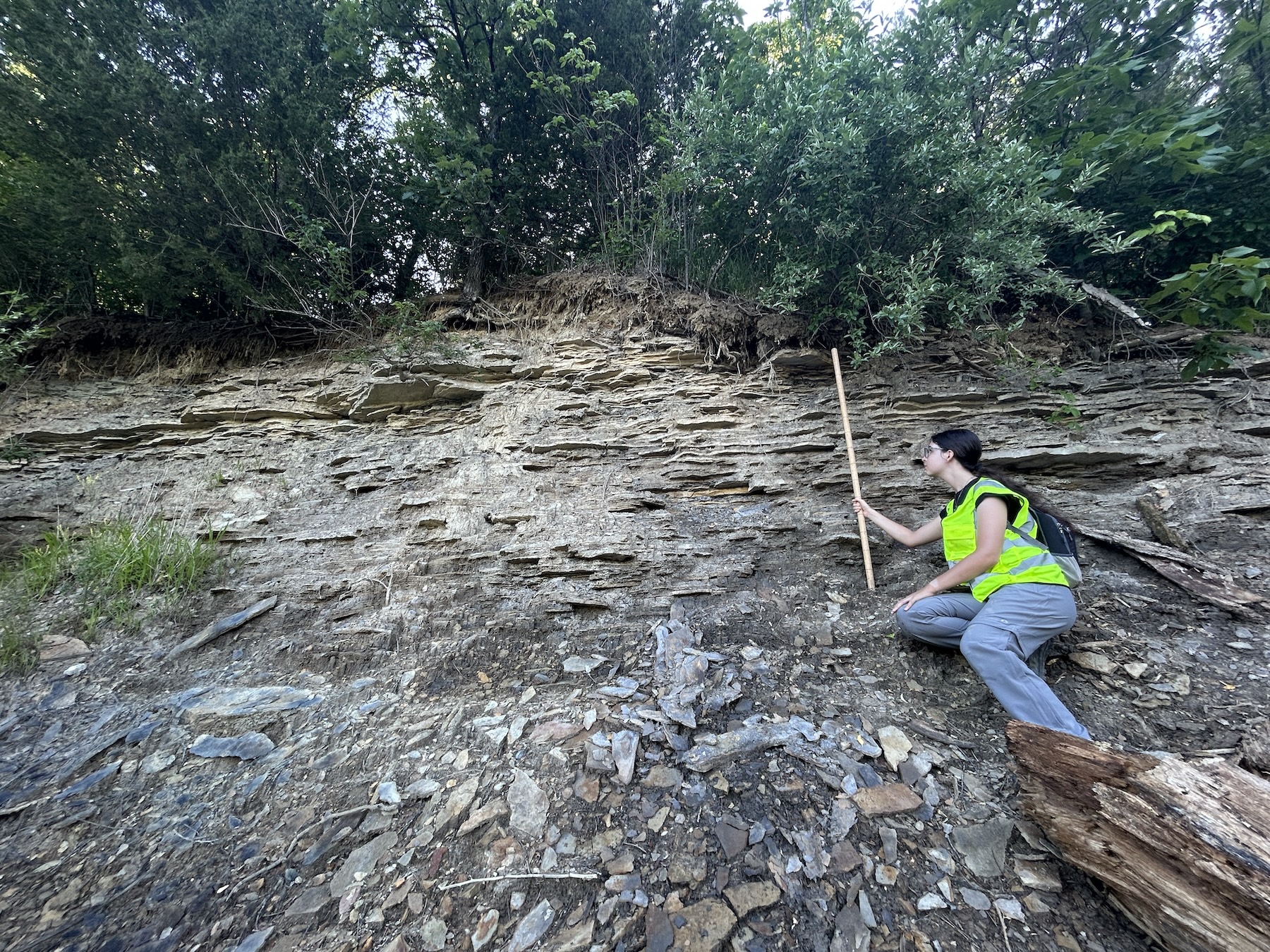
Baylor University doctoral student April Cerami examines fossil-bearing rock at Russell Wildlife Area in Mahaska County. Cerami is studying unusual growth defects in marine animals that lived in Iowa more than 300 million years ago. submitted photo
OSKALOOSA, Iowa — A fossil site at Russell Wildlife Area is helping researchers study marine animals that lived in Mahaska County more than 300 million years ago.
April Cerami, a doctoral student at Baylor University, traveled from Texas to study fossils found in exposed rock at the wildlife area. She was joined by Baylor University professor Elizabeth Petsios.
Cerami is studying unusual growth defects found in several kinds of ancient sea animals. She hopes the fossils will help explain what environmental conditions caused the animals to develop in unusual ways.
The research shows that the fossil beds at Russell Wildlife Area are more than a place for families to search for fossils. Instead, the site may contain evidence of an environmental problem that affected several groups of sea animals millions of years ago.
An Ancient Sea in Mahaska County
Mahaska County looked much different when the animals Cerami is studying were alive.
More than 300 million years ago, Iowa was closer to the equator, and much of the state was covered by a shallow sea. Marine animals lived in the water and on the seafloor.
When those animals died, some were buried by mud, sand, and other material. Over millions of years, those layers hardened into rock. The remains or impressions of some animals were preserved as fossils.
“This part of Iowa was underwater,” Cerami said. “It was marine habitat, so it had marine animals living in it, like trilobites and blastoids. Then those animals got buried and fossilized and are preserved here today on land.”
The rock Cerami is studying is part of the Pella Formation. The formation contains rock from the Mississippian Period, which ended more than 300 million years ago.
The formation is found in parts of southeastern Iowa, including Mahaska County, and it contains fossils from animals that lived in the ancient sea.
What the Researchers Are Looking For
Cerami is mainly searching for trilobites, blastoids, and crinoids.
Trilobites were marine animals with hard outer shells and bodies divided into several sections. They were distant relatives of modern crustaceans, including crabs, shrimp and lobsters.
Trilobites lived in oceans for hundreds of millions of years before becoming extinct.
Blastoids were small sea animals related to modern sea stars and sea urchins. Many were shaped like small flower buds and were attached to the seafloor by stems.
Crinoids are also related to sea stars. They are sometimes called sea lilies because many had a flower-shaped body attached to a long stem.
Crinoids still live in the ocean today, although many modern species live in deep water.
Cerami said the blastoids found at Russell Wildlife Area are smaller than those she studied while completing earlier research in West Virginia.
“The ones here are about the size of my pinky nail at their biggest, and there are babies at the site too, so they get way smaller,” Cerami said.
Visitors may also find brachiopods at the fossil beds. Brachiopods have two shells and can look similar to clams, although they are a different kind of animal.
Other fossils found at the site include pieces of crinoid stems, corals, and other animals that lived in the ancient sea.
Growth Defects Make the Site Unusual
Marine fossils can be found in several parts of Iowa. What makes Russell Wildlife Area unusual is the number of fossils that may show abnormal growth.
Cerami first learned about the site through earlier scientific research.
One study found growth defects in about 3% of the blastoids examined from the area. Cerami said that rate was much higher than scientists would normally expect to find in a fossil population.
Earlier research also suggested that trilobites from the same area may have had a high number of abnormalities.
That caught Cerami’s attention because blastoids and trilobites were very different animals.
Finding many abnormal fossils from both groups at one location may mean that an environmental problem affected several types of animals living in the ancient sea.
“There is reference to trilobites having similarly high occurrences of abnormalities,” Cerami said. “That makes this one of the first sites where you have two very distantly related animals occurring in one place with a high quantity of abnormalities in the fossil record.”
Cerami is studying the fossils as part of her doctoral dissertation.
What Could Have Caused the Defects?
Scientists do not yet know what caused the unusual growth.
One possible cause is a change in salinity, which is the amount of salt in the water.
Blastoids and other animals related to sea stars can be very sensitive to changes in salt levels. Even a small increase or decrease could place stress on the animals as they grew.
However, Cerami said changes in salinity may not fully explain the abnormalities.
Trilobites may have been better able to handle changes in salt levels, but if both trilobites and blastoids were affected, several environmental problems may have occurred simultaneously.
Possible causes could include changes in water temperature, low oxygen levels, or metals in the water.
Low oxygen in water is known as anoxia. Marine animals need oxygen in the water to survive. Low oxygen levels can weaken or kill animals, especially those that cannot move away from the affected area.
“There may have been a combination of factors going on within the environment,” Cerami said. “Possibly temperature, anoxia, heavy metal — something that was impacting both of them at the same time. So, I’m looking into why that might be.”
Cerami plans to study the chemical makeup of the fossils and surrounding rock. That information may provide clues about the water conditions in which the animals lived.
Fossils Can Show Injuries and Healing
An unusual fossil does not always mean an animal was born with a defect.
Some fossils show injuries that happened while an animal was alive. Others show how an animal healed after being damaged by a predator, disease, or another event.
Cerami said earlier researchers studied injured corals from Russell Wildlife Area.
She and Petsios found several examples during their visit.
“There’s another paper that referenced a bunch of injured corals from this site as well, and we found a bunch of those,” Cerami said.
Earlier research described the fossils as exhibiting some of the strongest evidence of healing in ancient corals.
The coral fossils appear to show that the animals survived severe damage and continued to grow. Their skeletons recorded both the injury and the healing process.
Those fossils can help researchers understand how ancient animals responded to injuries and stressful environments.
Cerami said unusual growth should not be dismissed as something that happened by chance.
“A lot of people treat animals with growth defects in the fossil record, and in the modern, as just anomalies,” Cerami said. “But they can tell you about their environment.”
Similar problems can be seen in modern animals.
If many animals in one area develop unusual body parts, the cause could be pollution, poor water quality, disease, or another environmental problem.
Fossils may provide the same kind of information about environments that disappeared millions of years ago.
Researchers Leave With a Trunk Full of Rock
Cerami and Petsios spent several days collecting fossils and rock fragments at Russell Wildlife Area.
The samples were placed into large sandbags for the trip back to Texas. By the end of the visit, Cerami said their vehicle’s trunk was full of rock.
The researchers collected fossils visible at the site, along with pieces still partly covered by surrounding rock.
The rock surrounding a fossil is called the matrix.
Cerami will carefully remove the matrix in a laboratory. The fossils will then be examined under a microscope.
That work will help her decide whether an unusual shape is a true growth defect, a healed injury, damage that happened after the animal died, or a change that happened as the fossil formed.
Cerami has also examined fossils from the site that are stored at the University of Iowa.
Those fossils were collected by earlier researchers. Cerami said she found several abnormal blastoids, one abnormal trilobite and an abnormal crinoid in the collection.
“I am fairly confident that the abnormalities are as common here as were stated,” Cerami said. “So now it’s just a matter of figuring out why.”
Cerami expects the project to take several years.
She is in the early stages of her doctoral program and has developed a three-year plan for this phase of her research. The work will include preparing the fossils, studying their chemistry, comparing abnormalities, and writing the results.
Cerami hopes to publish her findings in a scientific journal. Her finished dissertation is also expected to become available to the public.
Why Fossils Are Easy to Find at Russell Wildlife Area
Part of Russell Wildlife Area was once used as a limestone quarry.
Quarry work removed soil and exposed layers of rock that would normally be hidden underground, allowing visitors and researchers to see fossils more easily.
Weather continues to break the rock into smaller pieces.
Rain can wash away loose dirt and expose fossils that were previously hidden.
Cerami said rain during the visit may have helped reveal new material.
“We’re hoping especially this morning’s rain will have exposed some more fossils,” she said.
The exposed rock allows people to search for fossils without using heavy equipment, and many fossils can be found by looking through loose pieces of rock below the main rock face.
Cerami said the Pella Formation appears to contain more fossils in Mahaska County than at another location the researchers visited in Keokuk County.
“It seems compared to there, the formation here in Mahaska County has way more fossils — a surprising amount more fossils,” Cerami said. “Mahaska County is the place to be for these abnormalities, so now it’s just a matter of figuring out why.”
A Site the Public Can Explore
The fossil beds at Russell Wildlife Area are open to the public.
The fossil area is marked on the property’s maps. Visitors can drive near the site when access gates are open.
“You can sift through for hours and find all sorts of cool stuff,” Cerami said. “It’s really easy. Anyone can do it and find all sorts of stuff.”
Mahaska County Conservation also holds fossil programs for children and adults. Those programs teach visitors how to search for fossils and identify common examples.
Visitors should follow posted rules, avoid damaging the main rock face, and leave the area clean.
People should also be aware that Russell Wildlife Area includes a public shooting range. Visitors should follow signs and stay within the proper areas.
Millions of Years of Mahaska County History
Mahaska County is also known for mammoth remains discovered near Oskaloosa.
The mammoths lived thousands of years ago. The fossils at Russell Wildlife Area are much older.
The trilobites, blastoids, crinoids and corals lived more than 300 million years ago, long before dinosaurs appeared.
The two discoveries represent very different periods in Mahaska County’s past.
Mammoths walked across dry land during the Ice Age. The animals found at Russell Wildlife Area lived in a warm sea.
Cerami’s research may help explain what happened in that ancient environment and why several kinds of animals developed unusual features.
The fossils also provide local residents with a look at a time when Mahaska County was not covered by farms, towns, and roads.
It was part of an ocean filled with marine life.
“Lots of cool stuff here,” Cerami said.