Gov. Kim Reynolds signs property tax law projected to save $4.2 billion over 6 years
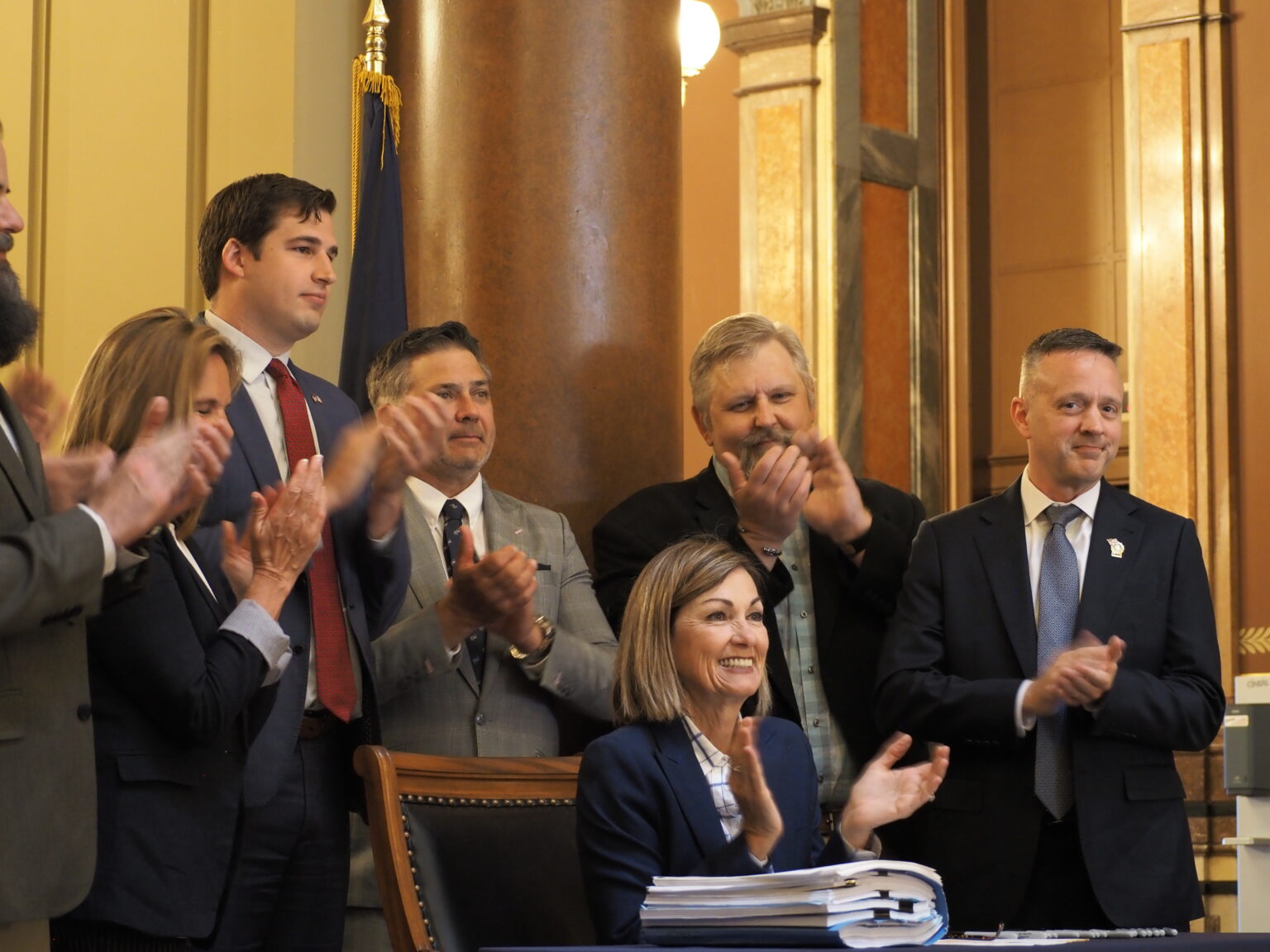
Iowa Gov. Kim Reynolds, joined by Republican leaders in the state Senate and House, signed a measure into law May 18, 2026, aimed at lowering property taxes. (Photo by Robin Opsahl/Iowa Capital Dispatch)
by Robin Opsahl, Iowa Capital Dispatch
May 18, 2026
Iowa Gov. Kim Reynolds signed into law May 18 a measure she and supporters say will lower property tax costs for Iowans — an issue Republicans said was their top priority for the 2026 session.
“We’re bending the spending curve away from government and back toward the families who fund it, and we’re creating another $4.2 billion dollars in tax savings over the next six years,” Reynolds said. “Most importantly, though we’re keeping our promise to the people of Iowa.”
The governor signed Senate File 2472 into law, joined by House and Senate Republican leaders who negotiated to create the final version of the proposal passed in the final hours of the legislative session earlier in May.
The new law incorporates portions of the original property tax bills put forward by the governor, House and Senate Republicans much earlier in the year: The law will implement a 2% annual limit on local government revenue growth. The cap allows certain exemptions, such as for school funding, county supplemental, city special revenue levies and community college variable levies. It also includes a higher cap of 4% for county hospitals and 3% for Des Moines Area Regional Transit and Iowa Emergency Management Association.
The measure also requires local governments to limit general fund reserves to 35% of the entity’s budgeted expenditures each year.
Reynolds said these changes will bring local governments in line with the state’s process for building a budget each year, which “projects revenue first, and then sets expenses.”
“They have to look at how they operate, just like we do,” Reynolds said. “They now will budget like the state level, where (the Revenue Estimating Conference) tells us the revenue that we can spend … and then we build our budget from that, and we prioritize based on what we really feel those dollars should be spent. And that’s exactly the same process that they’ll have to undertake.”
In addition to the revenue restrictions, there are other changes aimed at shifting education costs from the property tax funding stream to the state. One of those measures will speed up the equity transfer of revenue generated through the Secure an Advanced Vision for Education (SAVE) funding, currently dedicated to school infrastructure, to property tax relief. Another will lower the state $5.40 uniform levy set for school foundation property taxes, using state funding. The $5.40 levy would be lowered by funding created through eliminating the homestead tax credit and replacing it with a homestead property tax exemption, according to GOP lawmakers.
Reynolds said, “by lowering school levies while maintaining school funding, the state is now stepping up to carry a greater share of the responsibility easing the burden on families while keeping our commitment to strong public schools.”
Bill repeals tax cut for multi-residential property
Another portion of the bill makes changes to the state’s multi-residential property classifications. While the final law does not include larger shifts in taxes for these properties, like apartments, introduced in earlier Senate proposals, it still reverses some portions of a 2013 law by reclassifying these buildings as separate from residential properties where a homeowner resides, and increases the rate for multi-residential property taxes by 6% over three years.
Apartment owners and other advocates told lawmakers during session shifts to the multi-residential property code would increase rents for Iowans. But Sen. Dan Dawson, R-Council Bluffs, who advocated for these changes, called some of the 2013 law changes to lower taxes for these properties an act of “property tax cronyism” that did not result in lower rents for Iowans.
Dawson said Monday he believes the law shows Republicans’ commitment to supporting “the family home.”
“The thing I’m most proud of in this legislation is the governor and Iowa Legislature chose families and not corporations to have the best tax environment government here in the state,” Dawson said. “It took a lot to fight back all the associations (that were) every day trying to kill these bills and these reforms. But today, we say the family home comes first.”
The measure also includes some changes adding restrictions on Tax Increment Financing (TIF) districts, areas where property tax revenues are sent to projects within the district. TIF districts will be limited to a period of 23 years under the law, and full usage of the increment financing would drop to 60% with no new debt after 20 years.
The discussion on property tax legislation started in 2025, when Republicans held multiple meetings on legislation aimed at reducing Iowans’ property tax costs, but did not ultimately send a measure to the governor’s desk.
House Speaker Pat Grassley said Republicans “came in the last session with the goal knowing that Iowans expected us to get something done to provide certainty” for property taxpayers — and that the law signed Monday delivers on this goal.
“What you’re seeing here today is a unified Republican Party that was able to get something done that many thought would be unable to be accomplished,” Grassley said.
Iowa Capital Dispatch is part of States Newsroom, a nonprofit news network supported by grants and a coalition of donors as a 501c(3) public charity. Iowa Capital Dispatch maintains editorial independence. Contact Editor Kathie Obradovich for questions: info@iowacapitaldispatch.com.