Iowa House Republicans’ ‘tough on crime’ bills move forward
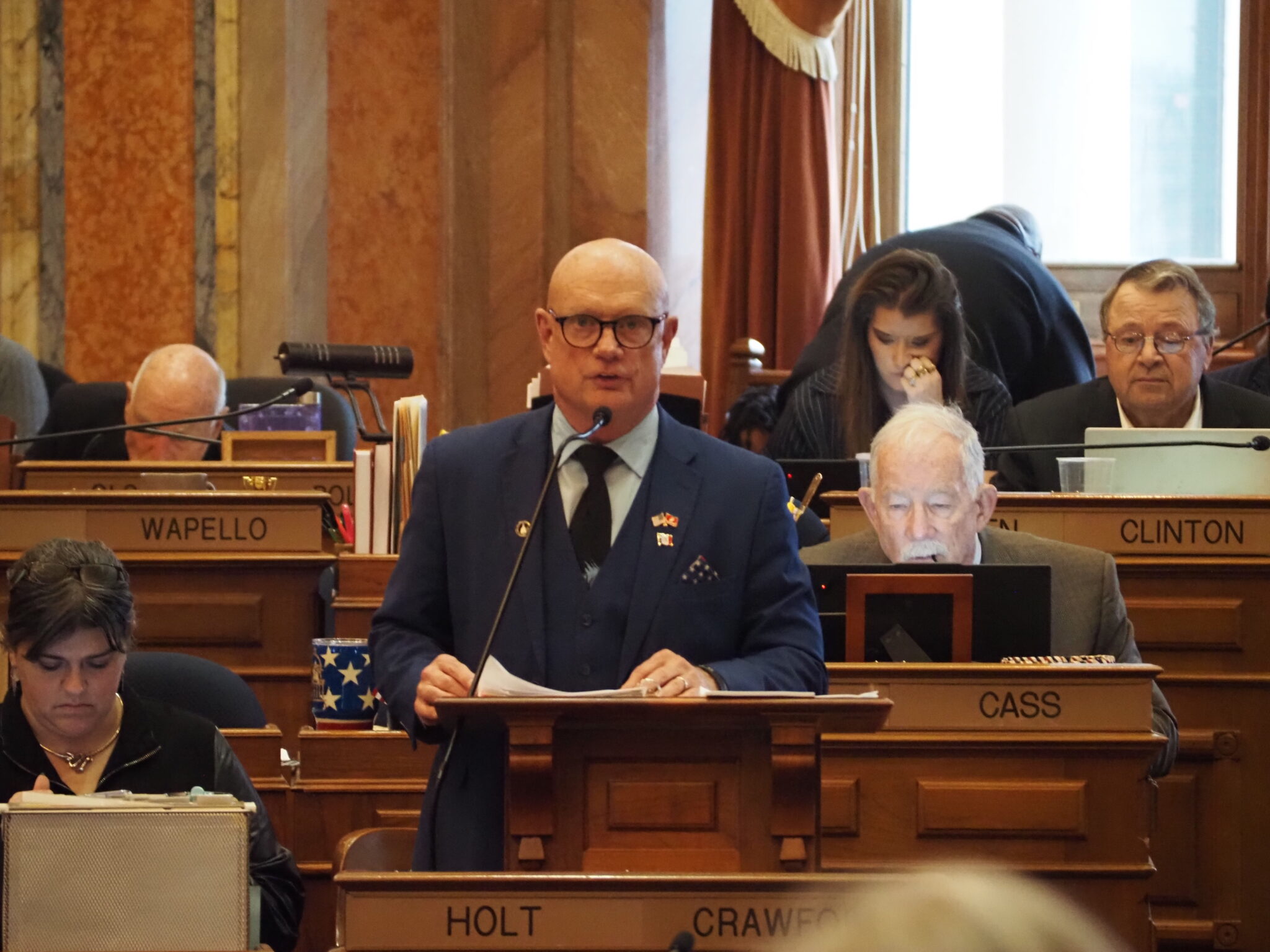
Rep. Steve Holt, R-Denison, spoke on the “three strikes” bill establishing a 20-year prison minimum for habitual offenders that passed the Iowa House March 4, 2025. (Photo by Robin Opsahl/Iowa Capital Dispatch)
by Robin Opsahl, Iowa Capital Dispatch
March 4, 2026
The Iowa House approved several bills Wednesday that are part of House GOP’s “tough on crime” package introduced earlier in the session, including a measure requiring a 20-year minimum prison sentence for repeat offenders.
House File 2542 was one of the major proposals put forward by House Republicans in January that aims to prevent “career criminals” from committing crimes in Iowa. The bill would create a “three strikes” system for committing certain crimes, in which a person would be subject to a minimum 20-year prison sentence if they accumulate three “points” under the system.
Rep. Steven Holt, R-Denison, the bill’s floor manager, said the measure is a way to ensure people who repeatedly commit lawless actions, showing “they are not willing to be rehabilitated, will be removed from civil society and incarcerated for a minimum of 20 years.”
One “point” would be given for people charged with felonies and aggravated misdemeanors including sexual abuse, domestic abuse assault, assault with intent to inflict a serious injury or the use or display of a deadly weapon, as well as organized retail theft. A half-point would be awarded for all other aggravated misdemeanors, as well as serious misdemeanors including assault and domestic abuse causing bodily injury or mental illness, and criminal mischief in the third degree.
The bill was amended to remove theft, possession of a controlled substance and harassment as crimes adding to the point system. It additionally creates a “20-year lookback,” Holt said, limiting the period of points accumulation to 20 years, and states that if a person faces multiple pending charges for an incident, only the most serious crime will be counted as a “point.” The measure also clarifies the point system would not count any convictions or crimes that occurred before the law’s enactment, and that if a person reaches the threshold for the 20-year prison sentence, their sentence cannot be deferred or suspended.
Holt said this amendment was an agreement reached with the Council of County Attorneys and other concerned parties to address “various implications of this legislation.”
Rep. Ross Wilburn, D-Ames, said he approved of the amendment despite having other problems with the bill. Wilburn introduced an amendment which would require the final strike triggering the 20-year minimum sentence to be a “forcible felony.” The amendment was defeated.
“Look, Iowans want safer communities, women want safer communities, people with disabilities, Black and brown communities want safer communities,” Wilburn said. “But expanding ‘three strike’ laws will intensify disparities … by mandating longer sentences, limiting judicial discretion.”
Wilburn and others also said the measure would add major costs to the state correctional and judicial systems.
According to the fiscal note from the Legislative Services Agency on the bill, the Department of Corrections (DOC) did not respond to “multiple requests for information,” and that both the correctional impact and fiscal impact of the bill could not be assessed. However, the LSA stated the bill is expected to have a significant impact on the state’s correctional system “with increases to the prison population over time due to increased (lengths of stay).”
Though the corrections department did not give the LSA fiscal information, the document stated the state’s correctional system would face approximately $164.9 million more in costs per fiscal year starting in Fiscal Year 2031. The estimate was based on the projected number of “habitual offenders” established under the bill each year and the marginal cost per day for prisons.
The LSA document also notes, “the DOC may incur additional costs due to prison overcrowding and the need to house an increased prison population.”
“An increase in the prison population due to increased (lengths of stay) will require the DOC to build additional prison(s). The size, security, and other features that a future prison may require cannot be determined, but costs would be significant. Additional costs would include staffing and operational requirements. Prison construction will take multiple years to complete, which may create unexpected costs for county jails,” the LSA note states.
According to DOC daily statistics, Iowa prisons are currently 24.54% over capacity as of March 4, with a prison population of 8,705. The state’s prison capacity is 6,990.
Wilburn questioned Rep. Brian Lohse, R-Bondurant, who chairs the House Justice System Appropriations Subcommittee, about the bill’s impact on the state’s correction system budget. Lohse said there will be additional costs if the measure is adopted, though he did not specify amounts. Lohse also acknowledged the state’s prison system is overcrowded and faces correctional staff shortages.
Holt said from his understanding, the DOC provided the Legislative Services Agency with its fiscal note late Tuesday night. This information is not yet available through the Legislature’s website. However, Holt said the DOC’s estimates on the fiscal impact of the bill is “a joke and it should be an embarrassment to the Department of Corrections.”
“It is clear in my judgment that because they did not like the legislation, they went all out and extreme to create a fiscal note that cannot be taken seriously in its assumptions,” Holt said.
He said the DOC’s estimates on the fiscal impact of the bill assume that crime will “continue as usual,” but House Republicans believe the measure will serve as a “deterrent” and reduce crime rates in the state. He said Republicans acknowledge the measure will result in higher costs to the state — but said these cost analyses are “one-sided,” as they do not consider the cost of crime to victims.
“The fiscal note focuses entirely on the cost of the criminal — the bed, the food, health care — while placing zero value on the victim,” Holt said. “Simply considering a conservative value of $10 million for the life of an Iowan, we can see that the cost of not incarcerating career criminals is a far higher cost, both monetarily and morally, than the cost of a prison cell.”
The measure passed 68-23.
Bills on bail scheduling, judicial performance website advance
Two other pieces of the House GOP anti-crime package, making changes to the state’s bail system and establishing a database to track judicial officers’ performance, also moved forward Wednesday.
Senate File 2399, passed 74-19, would require judges who deviate from uniform bond schedules to provide a written justification for why they are setting a lower bail. It also states that people arrested on charges of intimidation with a dangerous weapon, possessing or transporting a weapon by a felon, or a forcible felony cannot have their bail set below the uniform bond schedule or be released without a written justification.
The bill also bans “promise to appear” releases — when a person signs a document allowing them to be released from custody without going to jail — if the person faces simple or serious misdemeanor charges related to violence or drugs.
Any pretrial releases would require the Iowa Department of Corrections provide information to a magistrate for verification of the individual’s residency, employment and criminal record. It also would allow the bond schedule to be adjusted for inflation.
The measure was originally a different Senate proposal related to pretrial bond amounts that was amended to include the language of House File 2505 and sent back to the Senate.
Rep. Mike Vondran, R-Davenport, said the bill aims to ensure people accused of serious crimes are not released “without appropriate scrutiny,” while also streamlining the bail process.
“This balance between accountability and maintaining the presumption of innocence is a cornerstone of a just legal system,” Vondran said. “By adhering to a standardized bond schedule and requiring transparency in the deviations, this legislation strengthens the integrity of our judicial process, and … serves much better our entire community.”
House File 2719, passed 73-19, as amended would direct the Secretary of State to create a publicly accessible dashboard with data on judicial practices. Data on judges’ decisions related to setting bonds and pretrial releases, sentencing outcomes, decision reversals and courtroom efficiency. This data would be available through a website that includes the ability to search by name and county, as well as personal statements from each judge and district average statistics.
Rep. Charley Thomson, R-Charles City, said this website would provide more information to Iowans as they evaluate judges during judicial retention votes. The Iowa State Bar Association releases a Judicial Performance Review during Iowa elections where Iowans decide whether Iowa judges maintain their positions, but Thomson said the state website would provide more information.
Thomson said the measure “is designed to finally –really, for the first time in Iowa’s history — provide Iowans with a meaningful look into what their judges are doing.”
“This does not interfere with the business of judging,” Thomson said. “We would not presume to do that, it’s an independent branch of government. But what it will do is, for the first time, give Iowans an insight through statistical information … on how judges are ruling according to benchmarks that we have designated in the bill, that are actually in Code, that will be elucidated by statistics put on a website by the Secretary of State.”
The measure is expected to create a one-time cost of $1.3 million to $2.1 million for updates to the state’s Electronic Document Management System and the website’s creation, as well as create annual ongoing costs of between $350,000 to $700,000 for data analysis and maintenance of the website, according to the LSA fiscal note.
All three measures move to the Senate for further consideration.
Iowa Capital Dispatch is part of States Newsroom, a nonprofit news network supported by grants and a coalition of donors as a 501c(3) public charity. Iowa Capital Dispatch maintains editorial independence. Contact Editor Kathie Obradovich for questions: info@iowacapitaldispatch.com.