CONCLUSION OF THE 1904 SEASON
by Mike Comfort
Criticism of the umpires continued as the season marched to its end. In July, Redmond, the former Ottumwa pitcher who had been hired to umpire during the season after complaints about other umpires, was released by President Norton. In his spot he hired none other than William Tiley, who had just recently been fired as manager by Oskaloosa. He quickly racked up a poor reputation. The Waterloo Courier said that Tiley ‘had trouble with his eyes and needed to go to an optician’s office’. The paper said that he was the worst umpire in the league and that his biggest issue was that he would constantly stop and try to explain his decisions. Oskaloosa forfeited a game to Waterloo in the 3rd inning after objecting to an umpire’s decision. Tiley was the umpire. The Marshalltown Times noted in a game between Boone and Waterloo that many decisions by Tiley were questioned. Burlington was also noted to have issues with Tiley. Marshalltown filed a protest against Tiley and in response, President Norton sent Quigg to umpire. Quigg ended up being the only umpire who umpired the whole year and was considered the best umpire in the league by the Waterloo Courier.
On the bright side, the league was expected to make it through the season with every team, which was not expected at the first league meeting. President Norton stated that the league was up $300-500 over expenses, ensuring that the league was in good financial shape. The biggest question was what teams would constitute the league in 1905. President Norton hoped that the financial success of the team would entice schools of the Three-I to join the Iowa League. In various papers it was reported that Cedar Rapids, Davenport, and Dubuque could leave to join the Iowa League. In this scenario, Oskaloosa, Burlington, and Boone would be dropped. The Waterloo Courier reported that Des Moines of the Western League was interested in joining, although this seems like conjecture as the capital city didn’t make much sense in a league with smaller towns. No matter what happened, there was strong optimism of the future of the Iowa League.
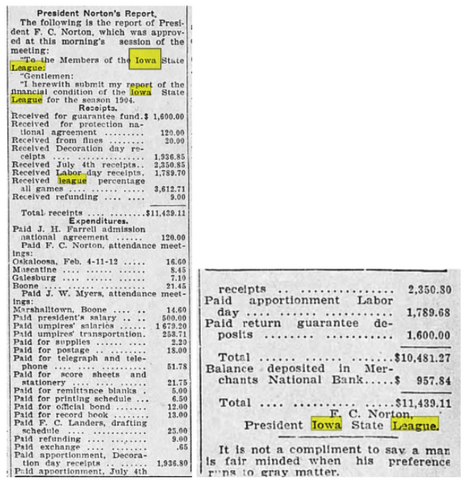
President Norton’s Financial Report
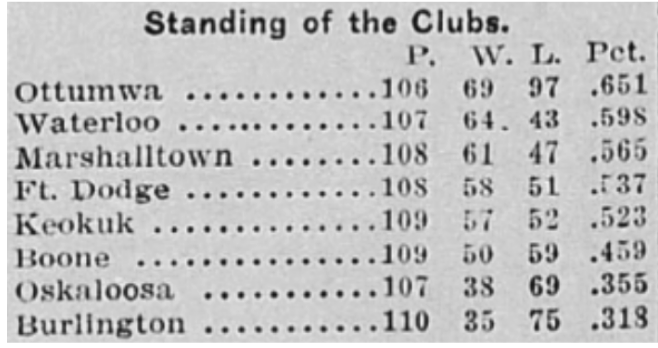
Ottumwa was one of two teams to have an above .500 record in August (Waterloo being the other), and they rode their 21-6 mark to clinch the first Iowa League pennant with a 69-37 record. Waterloo went a sterling 19-8 in August, but they’d finish 5 games behind Snapper Kennedy’s crew. Marshalltown was an even 12-12 in August and they’d finish in 3rd at 61-47. Ft Dodge lost 6 of their last 8 to fall into 4th place (58-51) while Keokuk finished a game back at 57-52. Boone went 1-15 in August, then rallied to finish 10-2, but was still only able to finish in 6th place at 50-59. The race for last place between Burlington and Oskaloosa came down to the last week of the season. Burlington finished the season 7-22 while Oskaloosa won 6 of their last 7 to edge past Burlington with a 38-69 record. Burlington finished 35-75. The Burlington Hawkeye disputed Oskaloosa and Burlington’s records and had them at 38-69 and 36-73 respectively, which wouldn’t change the order. One of the games that Oskaloosa won that put them ahead of Burlington was a 3-1 victory over Keokuk when a ball went through a hole in the fence for a homerun. The Herald rubbed it in to their counterpart in Burlington as they had been ‘mean’. After the season, a state championship series was proposed between Des Moines of the Western League, Davenport of the Three I League and Marshalltown of the Iowa State League. Why Ottumwa wasn’t named is not known. The winning team would have won $1000, 2nd place $500, and 3rd place $250. The series does not seem to have been played.
Marshalltown Times (9/6/1904)
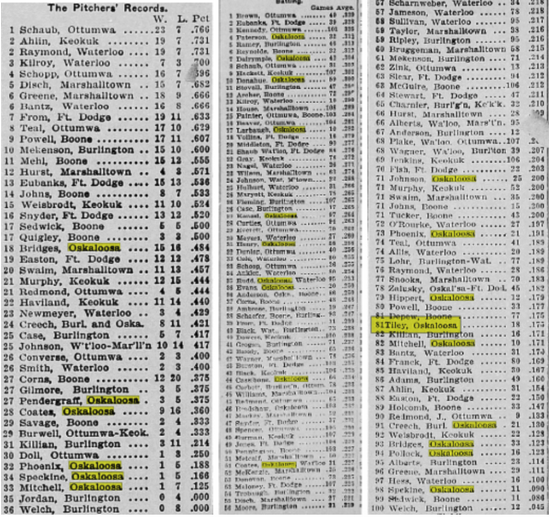
Ten players hit above .300, including 3 from Ottumwa and Oskaloosa. Brown of Ottumwa won the batting title with a .339 average outdistancing Eubanks of Fort Dodge by 11 points. However, only 2 of those 10 players played in 100 games. 7 of the players played in less than 50 games and another played in just 59 games. Kennedy of Ottumwa hit .325 in 101 games while Hackett of Keokuk hit .301 in 107 games. An argument could be made that these two were the real batting leaders in the league. Waterloo and Marshalltown were the only teams to not have a player hit above .300. Schaub of Ottumwa had the best pitching record at 23-7 and he was the only player to win 20 games in the league. Three players finished with 19 wins, while Corns of Boone was the only player to lose 20 games, with a 12-20 record.
Multiple players that played in the Iowa League would play in the majors. Both James Archer of Boone and George Stovall of Burlington would play 12 years in the majors. Ham Patterson of Oskaloosa played for the St. Louis Browns for 17 games and 1 game for the Chicago White Sox in 1909. He accumulated 10 hits and played in the minors through 1918 at the age of 40. John Eubanks of Fort Dodge pitched for the Detroit Tigers from 1905-1907 and finished with an 8-13 record. The Tigers would win the AL pennant in 1907. One of Eubank’s teammates in 1905 was George Disch of Marshalltown who was 0-2 in his lone stint in the majors. Waterloo had a number of players who played in the major leagues. Benny Meyer, who made $100 a month during the Iowa League season, would play for Brooklyn in 1913 and the Phillies in 1925 with a stint in the Federal League with Baltimore and Buffalo from 1914-1915. He finished with 276 total hits. Bugs Raymond, who finished with a 19-7 record, played for Detroit, St. Louis, and the New York Giants over the course of six seasons. His overall record was 45-57 and led the NL in losses in 1908 with 25. Tom Hess had some major league experience before joining Waterloo, playing for Baltimore in 1892 for 1 game. Fred Bridges’ had a tryout with the Pirates, but would never make it into the big leagues. He would pitch in the Three I League in 1905 and 1906, before returning to the Iowa League in 1907 with Waterloo.
End of year stats (Marshalltown Times 10/31/1904)
President Norton was re-elected as president and the league finished the season with a treasury balance of $957.84. The league brought in $11,439.11 compared to $10,481.27 in expenses. One of the biggest revenue streams was the July 4th games which brought in $2,350.85 while Labor Day games brought in $1,789.70. Norton himself took a $500 salary and paid the umpires a total of $1,679.20. Overall the league was in strong financial health. Norton said that the 10 percent gate, more than paid the expenses of the league. All teams were expected to return for the 1905 season, although he thought it was possible for 4 teams from the Three I League to join for 1905. Marshalltown led the league in attendance with a total of 23,117, averaging out to 492. Burlington was the only other team to break 20,000 (21,356). Fort Dodge had the lowest attendance with 13,582 total fans or 277 per game. All of the other teams averaged between 340 and 418 per game.
All in all the Iowa State League was a success in its first year. They completed a whole season, finished the season in the black, and had some exciting players. Accomplishing this while starting from scratch and navigating controversies was impressive.
Sources
Oskaloosa Herald, Quad City Times, Ottumwa Courier, Marshalltown Times, Waterloo Courier, Davenport Times, SABR
This article is copyright Mike Comfort and used with his permission. You can read more at his Substack by clicking HERE.
Mike Comfort is an Oskaloosa native as well as a baseball and history buff. He resides in Oskaloosa and is an educator and coach.