Lahn says cancer crisis isn’t partisan and it must be solved in Iowa
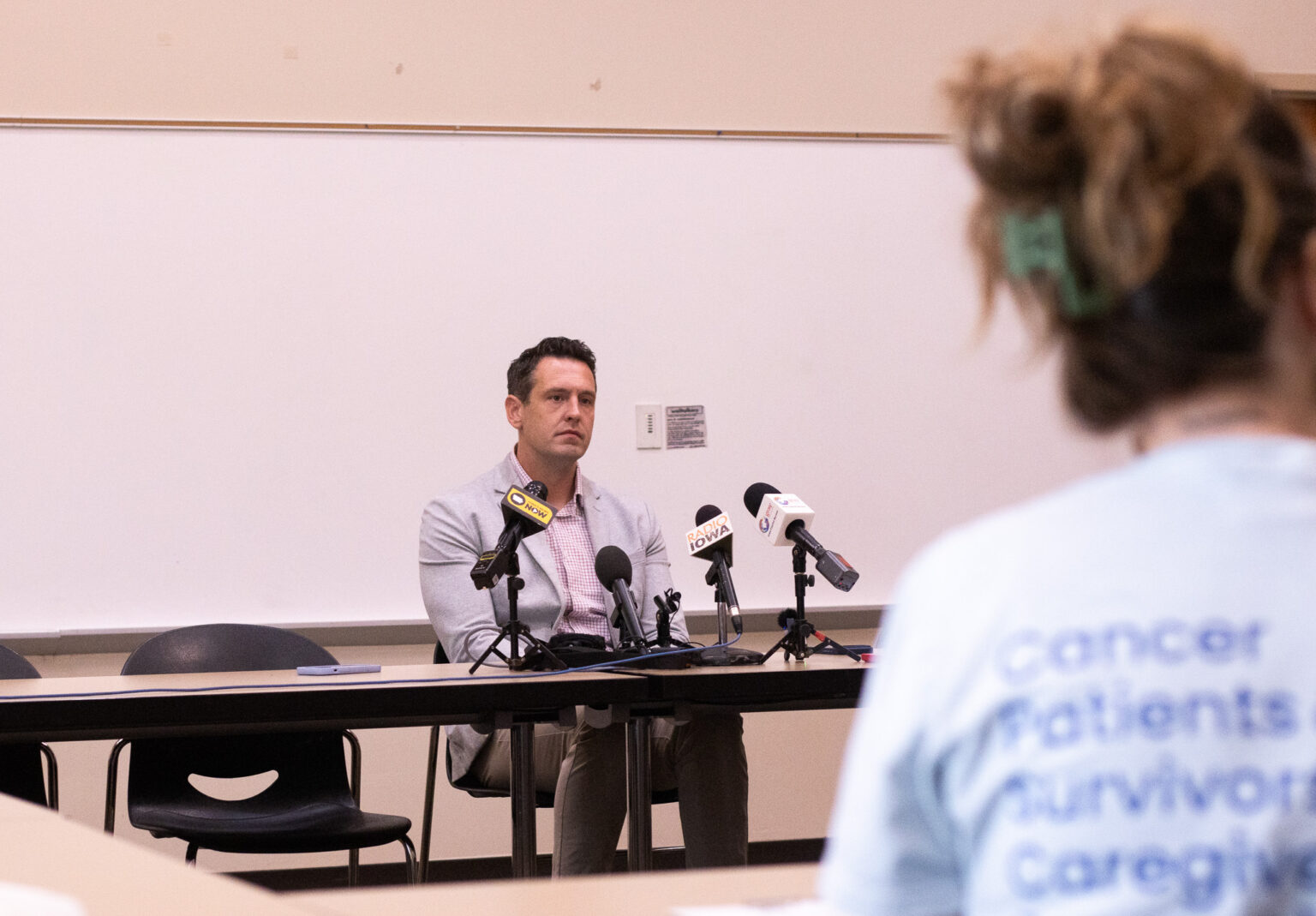
Republican gubernatorial candidate Zach Lahn at an American Cancer Society Cancer Action Network in Urbandale Aug. 18, 2026. (Photo by Cami Koons/Iowa Capital Dispatch)
by Cami Koons, Iowa Capital Dispatch
August 18, 2026
Republican gubernatorial candidate Zach Lahn said Tuesday that Iowa’s cancer crisis was one the reasons he entered the race and said regardless of party, it’s a problem that has to be solved.
Lahn spoke in Urbandale with cancer survivors and volunteers with the American Cancer Society Cancer Action Network as part of the organization’s “coffee cancer chat” event series which asks politicians about their stances on key cancer policy issues.
After listening to testimonies from more than a dozen event participants about their struggles with cancer diagnoses, paying for treatment, losing loved ones and living with the after-effects of cancer treatment, Lahn shared his own story of his father’s fight with non-Hodgkin lymphoma.
Lahn choked up as he explained his father’s diagnosis several years ago that led to a rapid cognitive decline, and other calls he has received about friends diagnosed with cancer.
“It’s not normal. It’s not right,” Lahn said. “Cancer has become a flashpoint in my own campaign, and the reason it has is because, I think I’ve been giving a voice to people who traditionally didn’t think they had a person to talk about it, especially in the Republican Party.”
He said he was under “no illusion” that he would win the Republican primary in June, considering people in his own party told him he wouldn’t win if he talked about water quality and cancer. Lahn said a “serious discussion” about cancer must include a discussion on nitrate load and water quality.
“It doesn’t matter if you’re left or right – you’re drinking the water, you have a family member who’s got cancer, we all have,” Lahn said. “ … We have to solve it.”
Lahn is the latest in a slew of candidates on the November ballot who have participated in the organization’s coffee cancer chat series, including Democratic gubernatorial candidate Rob Sand, who participated in late July.
Advance testing
Lahn said he was supportive of programs that improved access to screening and early detection of cancers. Many of the cancer survivors in the room noted that they developed their cancers at a younger age than when most doctors would screen for the diseases.
Lahn said he and his wife use a screening tool that detects early cancer signs via a blood test. He said he would like to initiate large contract pricing through the state to offer the tests, which cost more than $800 for an individual, to the “most vulnerable populations” in the state.
When speaking with reporters after the event, Lahn also said he wants Iowa to research the safety of certain products, including pesticides. He noted similar efforts have been done in Florida to test products like bread, candy and infant formula for harmful ingredients.
Redirecting university priorities to cancer research
Lahn said he would continue to support state funding for pediatric cancer research at the University of Iowa, but also suggested university funding that currently goes to other departments and degrees be redirected to things like pediatric cancer research, which he said has a higher “value proposition.”
“It’s not just adding more on top, but it’s also shifting the buckets that our money is going into right now, because it can’t just be that everything has the same sort of value proposition attached to it,” Lahn said. “Saving lives of people, and especially children, is one of the highest value propositions you could have.”
Sand, when asked the same question during his coffee chat, said he supported expanding the up to $3 million in pediatric cancer research funding approved by the state Legislature and Gov. Kim Reynolds in May.
That funding will come from the state’s new 5-cent tax on vapes and alternative nicotine products purchased in the state.
Tobacco tax
As part of the American Cancer Society Cancer Action Network event, volunteers asked participating politicians if they would support raising tobacco taxes by $1.50 per cigarette pack, and making taxes on other tobacco and nicotine products equivalent to 50% of the products’ wholesale price. These figures, the organization argued, would help reduce lung cancer rates in the state.
Lahn said he wants to see tobacco use decrease, but didn’t commit to the “very specific” policy proposals presented.
He said while there is “something positive to be gained” out of raising taxes to those levels, he wants to be cognizant of the “second order consequences” of raising the price of an addictive product.
“If we were to raise a tax on cigarettes or nicotine products, I would not support it if there was not a commensurate increase in the ability for us to help people get off of the product in the first place,” Lahn said. “Because otherwise, what we’re doing there is essentially a poverty tax, and you’ll hurt the people that are actually in the most need in our society.”
Sand also did not commit to the tax rates proposed by the organization when asked in July, but said he supported raising the taxes.
Medicaid expansion
While Lahn’s opponent has said he wants to end the privatization of the state’s Medicaid program, Lahn said Tuesday he believes using managed care providers, or MCOs, is the “right idea.”
“My goal is to make sure that with Medicaid that we’re getting good service, prompt payment, we’re not using AI in the decision making of claims … and also that we are not having vertical integration to make sure that the price is affordable,” Lahn said.
Lahn said he was “committed” to maintaining Medicaid access and Medicaid expansion for Iowans. He noted criticisms of his past, when he worked for a group that advocated against Medicaid expansion, and said there were some “real problems” with Medicaid expansion when it first came out. Namely, he said there was “no mechanism” to stop the federal government from “ratcheting down” its support, which would leave states with an “unbelievable burden.”
He also defended work and volunteer requirements in the program and said he believes “there’s a benefit” to being out in the community for those who are able to do so.
Democrats have argued work requirements, as laid out in a state law and in the 2025 federal budget reconciliation bill, will push eligible Iowans out of the program.
Vaccines
While Lahn has been critical of vaccine policies, especially mRNA vaccines and the COVID-19 vaccines, he said didn’t have a plan to restrict human papillomavirus, or HPV, vaccinations, which the American Cancer Society Cancer Action Network holds can help prevent cervical cancer.
Cervical cancer was the most common cancer among the survivors at the event. Earlier this year, the Iowa Legislature passed a law that restricts minors from receiving HPV or hepatitis B vaccines without parental consent.
“I think it’s between you and your doctor, also between a parent and their doctor for their children,” Lahn said. “So, my goal is to have safe, effective, and tested products available to people that would like to use them.”
Iowa Capital Dispatch is part of States Newsroom, a nonprofit news network supported by grants and a coalition of donors as a 501c(3) public charity. Iowa Capital Dispatch maintains editorial independence. Contact Editor Kathie Obradovich for questions: info@iowacapitaldispatch.com.