Iowa’s Deer Population Comes at a Cost: Crashes, Injuries, Deaths and Property Damage

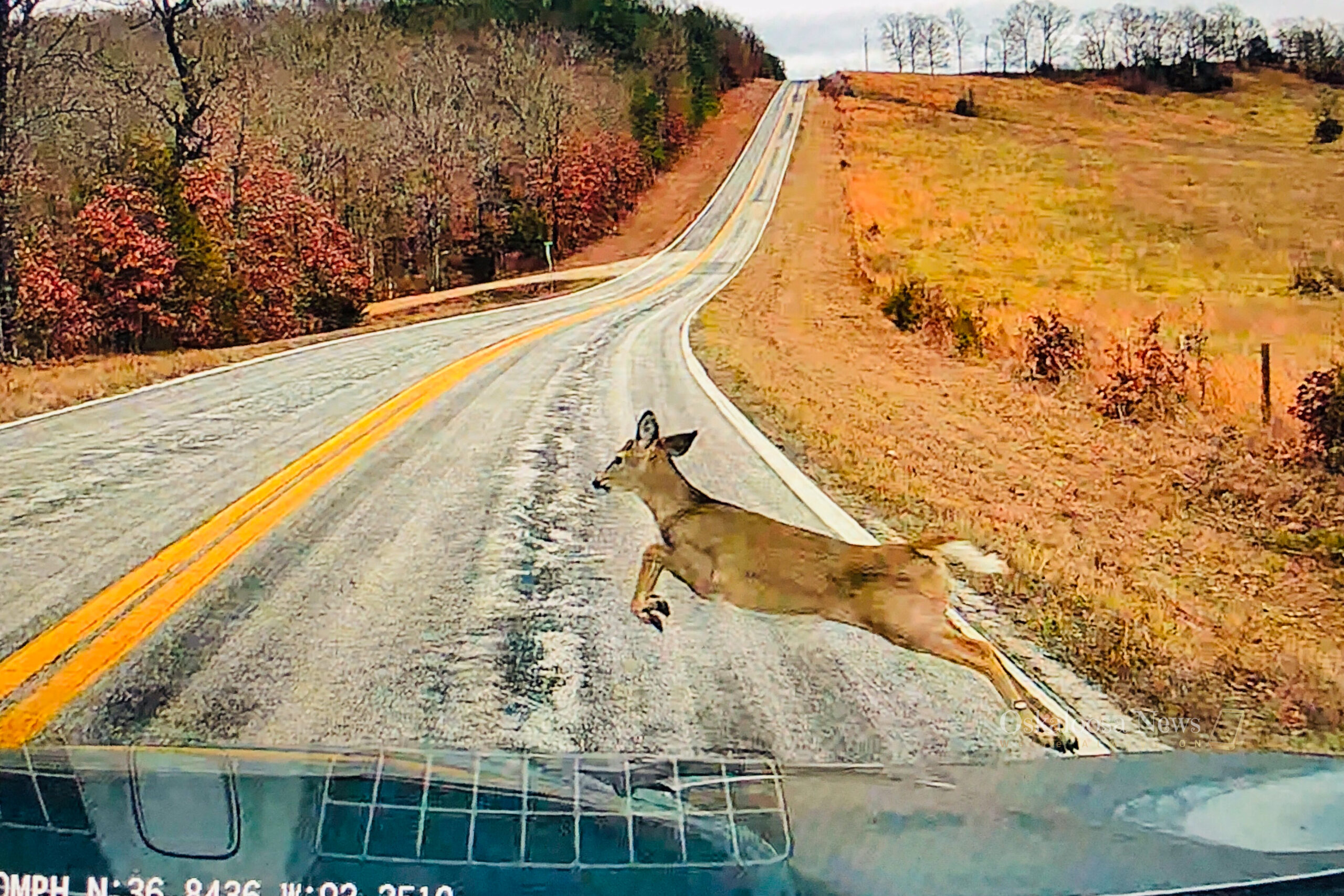
A white tail deer runs in front of a moving vehicle. (Oskaloosa News file photo)
Iowa ranks sixth nationally for animal collisions, while deer-related crashes cost the state an estimated $129 million annually.
OSKALOOSA, Iowa – Iowa’s white-tailed deer are important to hunters and wildlife fans, but they also create challenges for drivers, farmers, property owners, and taxpayers.
Every year, thousands of drivers hit deer. Some have to pay for costly repairs, and others are seriously hurt or even killed.
Meanwhile, deer hunting generates millions of dollars for Iowa’s economy and helps fund wildlife conservation programs.
The big question is whether Iowa has struck the right balance between keeping deer populations healthy and protecting people from the problems they cause.
Deer Collisions Remain a Serious Problem
Ethan Zieglowsky of Mahaska County Conservation recently visited the Oskaloosa News studio to discuss increased deer activity and roadway safety.
He said that on one day last week, the Oskaloosa Police Department and Mahaska County Sheriff’s Office got five deer-related crash calls in just 25 minutes. Within an hour, that number rose to about seven or eight.
Zieglowsky explained that November is during the deer breeding season, called the rut. Bucks move around more as they look for does, so they pay less attention to cars.
When fields are harvested and food sources change, deer move into new areas.
Deer are most active at sunrise and sunset, but drivers can see them on the road at any time.
Iowa Among the Most Dangerous States for Animal Collisions
According to State Farm’s September 2026 analysis, Iowa ranks sixth nationally for the likelihood of a vehicle collision involving an animal.
Iowa drivers have about a 1-in-81 chance each year of filing an animal-collision insurance claim. The national average is 1 in 145.
A separate Farmers Insurance report placed Iowa third nationally for the percentage of comprehensive insurance losses involving animals.
Iowa Department of Natural Resources records show approximately 7,300 animal-related vehicle collisions were reported statewide in 2025.
These numbers include animals besides deer, but deer are the main concern on Iowa roads.
The real number of collisions may be higher because not all crashes are reported.
The Human and Financial Cost
A 2024 Iowa State University study examined deer-vehicle collisions using state crash records from 2014 through 2023.
Researchers estimated an annual average of approximately 7,560 reported deer collisions.
Those records included an average of 356 crashes involving suspected or possible injuries, including 32 crashes involving suspected serious injuries.
The study also found an average of 3.5 fatal crashes annually.
Separate Insurance Institute for Highway Safety records show 36 people died in animal-related vehicle crashes in Iowa between 2015 and 2024. Five of those deaths occurred in 2024.
Not all those deaths can be confirmed as deer-related.
The Iowa State study estimated the total annual economic cost of deer-vehicle collisions at $128.6 million.
This total covers vehicle damage, medical bills, deaths, emergency services, towing, and other expenses.
The estimated average economic cost was approximately $17,012 per reported collision. That number isn’t the average repair bill. Researchers estimated about $5,807 for vehicle repair or replacement in crashes that caused damage. damage.
Drivers might also have to pay insurance deductibles, lose wages, or cover other costs.
The study doesn’t say exactly how much deer collisions raise the average Iowan’s insurance premium.
Farmers and Property Owners Face Additional Losses
Car crashes are just one part of the problem.
The Iowa State University study estimated that deer cause approximately $5.2 million in annual corn production losses.
Specialty crops, including fruits, vegetables, and nursery plants, suffer another estimated $3.4 million in annual damage.
Growers also spend approximately $832,000 each year trying to prevent deer damage to those specialty crops.
Deer can ruin young plants, break fences, and eat crops before farmers can harvest them. Homeowners also deal with damage to trees, gardens, shrubs, and landscaping.
These losses don’t show up in the vehicle crash statistics.
Altogether, the study estimates that deer-related vehicle and farm costs add up to about $138 million each year.
Hunting Revenue Creates a Difficult Balance
Deer hunting is also an important part of Iowa’s economy.
The Iowa State study found that deer hunting license sales and nonresident preference points generated approximately $12.2 million annually between 2020 and 2023.
The study estimated that deer-related activities provide at least $181 million in annual economic benefits, including spending connected to hunting and other activities.
That larger economic number isn’t money paid straight to the state.
Money from hunting licenses helps pay for wildlife conservation programs, so deer management is closely tied to hunting.
However, the available research does not prove that Iowa deliberately keeps deer numbers high simply to sell more hunting licenses.
In fact, the Iowa DNR reports that statewide deer numbers have generally stabilized or declined in recent years.
Still, this financial link brings up an important public policy question.
How much risk and property damage should Iowans have to accept to keep deer populations that also bring recreation and economic benefits?
Who Determines Iowa’s Deer Population?
The Iowa DNR manages deer populations through hunting seasons, license limits, special hunts, and county-level management decisions.
State officials consider deer population estimates, hunting activity, agricultural complaints, roadway collisions, and other information.
Iowa’s deer population increased significantly during the second half of the 20th century. State management practices initially encouraged that growth before later shifting toward population control in areas experiencing problems.
Today, the DNR says it aims to balance hunting opportunities with farm concerns, car crashes, and wildlife conservation.
Hunting remains the primary tool for managing deer numbers.
But with so many crashes, injuries, and property losses, some wonder if deer management should focus more on public safety and property damage.
Finding the Right Balance
Deer are a key part of Iowa’s wildlife, and hunting brings both economic and recreational benefits across the state.
But it’s important to weigh those benefits against the costs.
Losing an estimated $138 million each year to deer-related vehicle and farm damage is a big financial burden.
Even more importantly, people in Iowa are still getting hurt or killed in crashes with animals.
Zieglowsky advised drivers to stay alert in the fall, look out for more deer if one crosses the road, and drive at speeds that give them time to react.
These steps can lower the risk, but they can’t eliminate it completely.
The bigger question is whether Iowa’s current deer management really protects drivers, farmers, and property owners. With lives and millions of dollars involved, that question deserves continued attention from state officials and the public.